What Is a Contour Bra? Ultimate Guide to Seamless Shaping
A contour bra is a bra with molded foam cups that hold a preformed, rounded shape on their own, even when removed from the body. This design creates a smooth, seamless appearance under clothing without adding significant volume. Readers who want to eliminate visible seams, avoid show-through, and maintain a polished silhouette every day will find contour bras one of the most practical everyday wardrobe staples available.
What Makes a Contour Bra Different From Other Bra Styles
A contour bra is defined by its molded foam cups, which are heat-shaped into a three-dimensional form during manufacturing. Unlike lined bras that use flat fabric layers, contour cups retain their curved shape whether or not a breast is inside them.
This structural difference produces two practical outcomes. First, the cup holds its form against the body rather than conforming to it, which smooths the silhouette under fitted tops. Second, the bra does not flatten or crumple when washed, provided it is stored and handled correctly.
A contour bra is a type of molded bra, which is itself a subcategory of the broader everyday or T-shirt bra category. Molded bras include any style with heat-formed cups, while contour specifically describes cups shaped with a defined, rounded projection that mimics the natural breast contour. This distinction separates contour bras from foam-lined bras that add volume through layered padding rather than preformed shaping.
The molded foam used in contour cups typically consists of polyurethane foam bonded to a stretch fabric shell. Cup thickness ranges from 3 mm to 8 mm depending on the style, which determines both the level of structure and the degree of nipple coverage the bra provides. Getting this distinction right is the foundation for every fit and styling decision that follows.
Contour Bra vs. Padded Bra: Understanding the Core Difference
The most common source of confusion in this category is the difference between a contour bra and a padded bra. These two styles are not the same thing, and conflating them leads to purchasing the wrong bra for a specific need.
A padded bra is designed to add cup volume. It uses removable pads, sewn-in foam inserts, or thick push-up gel layers to increase the apparent bust size, typically by one cup size or more. The padding is the point. A contour bra, by contrast, uses foam to maintain shape and provide coverage, not to increase size. The foam in a contour cup is structural, not volumizing.
Use the table below to identify which style matches your primary goal.
| Feature | Contour Bra | Padded Bra |
|---|---|---|
| Primary function | Shape and coverage | Volume enhancement |
| Cup construction | Heat-molded foam, uniform thickness | Removable or sewn-in inserts, thicker at base |
| Size change | None | Adds 1/2 to 2 cup sizes |
| Nipple coverage | Yes, consistent across cup | Yes, but varies by padding placement |
| Visible seams | None on outer cup surface | Varies by style |
| Best for | Smooth silhouette under fitted clothing | Creating or enhancing cleavage |
The key takeaway is that a contour bra is about shape consistency, while padded bra is about size increase. Choosing a contour bra when the goal is a no-show, natural result under a fitted shirt is the correct application of this style.
Choosing the correct category from the start saves both money and fitting frustration.
How Contour Bra Cups Are Constructed
Contour cups are manufactured through a heat-molding process in which flat polyurethane foam is pressed between heated molds to create a permanent three-dimensional shape. The foam is fused to inner and outer fabric layers during this process, which bonds all three components without seams on the cup’s outer surface.
This seamless outer surface is what makes contour bras invisible under thin fabrics like jersey, silk, and modal. Seamed cups (such as those in balconette or full-coverage styles) have stitched darts that shape the cup but create visible ridges through lightweight tops. Contour cups eliminate those ridges entirely because the shape is built into the foam structure, not sewn into the fabric.
Foam Thickness and What It Controls
Contour cup foam thickness ranges from approximately 3 mm to 8 mm and directly controls three variables: nipple coverage, warmth, and silhouette definition. Thinner foam (3 to 5 mm) is classified as lightly lined and provides nipple coverage without adding noticeable structure. Thicker foam (6 to 8 mm) delivers more defined projection and a rounder silhouette, but adds warmth, which can be uncomfortable in hot climates.
Most everyday contour T-shirt bras use foam in the 4 to 6 mm range. This thickness provides sufficient nipple coverage and silhouette smoothing without the bulk of a push-up style. Manufacturers including ThirdLove, Wacoal, and Warner’s document foam thickness in their product specifications, making it possible to verify this detail before purchasing.
Lightly Lined vs. Moderate Contour Padding Levels
Within the contour category, padding levels are typically described as lightly lined, lightly padded, or moderately padded. These terms indicate foam thickness and do not imply any size change. A lightly lined contour bra uses 3 to 4 mm foam and provides minimal added structure. A moderately padded contour bra uses 6 to 8 mm foam and creates a more defined rounded shape.
Neither level changes cup size. Both eliminate visible seams and provide nipple coverage. The choice between them depends on whether the wearer prefers a natural, close-to-body silhouette (lightly lined) or a more rounded, projected shape (moderate).
Understanding foam thickness categories makes it possible to shop by specification rather than by guesswork.
The Seamless Appearance: Why Contour Bras Work Under Clothing
The defining practical benefit of a contour bra is its no-show performance under fitted clothing. This benefit results directly from the seamless outer cup surface produced by the molding process.
A 2017 consumer study by Mintel on intimate apparel purchasing found that 62% of bra buyers cited “no show-through under clothing” as a top purchase criterion. Contour bras address this criterion more consistently than seamed or unlined styles because the smooth foam surface creates a single continuous curve rather than multiple fabric panels meeting at visible seam lines.
The no-show performance of a contour bra depends on three additional factors beyond cup construction. Cup color must match or approximate skin tone when worn under white or very light fabrics. Band fit must be snug enough that the bra stays in position throughout the day without riding up. And the cup must fully contain the breast tissue without gaping at the top, which would create a visible fold through fitted fabrics.
How Contour Cups Maintain Shape When Empty
A contour cup holds its molded three-dimensional shape even when the bra is not being worn. This characteristic distinguishes contour bras from all other cup constructions. Soft cup bras collapse flat when removed. Underwire bras with unlined cups partially hold shape due to the wire frame but have no foam structure. Contour cups stand upright on a flat surface because the foam is permanently set in its molded form.
This behavior has a direct practical consequence: contour bras must not be folded or compressed during storage. Folding the cup forces the foam out of its molded shape and creates creases that do not fully recover. Bra storage guides from lingerie retailers including Nordstrom and Soma consistently recommend storing contour bras upright in a drawer, one cup nested inside the other, never folded in half.
Correct storage directly extends the functional life of a contour bra by preserving the cup’s molded geometry.
Contour Bra Fit: How to Assess Whether Your Cup Is Correct
A contour bra fits correctly when the breast fills the molded cup completely from the inside, creating a smooth transition between breast tissue and cup edge at the top of the cup. This is the single most important fit check for this style.
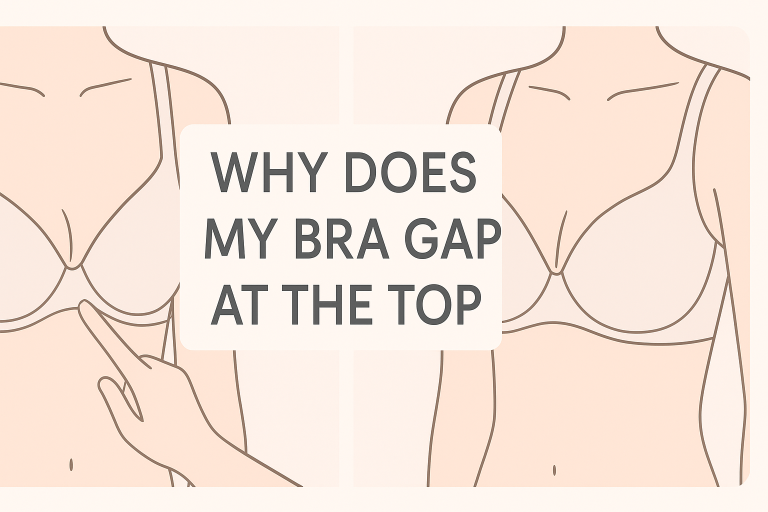
If the breast tissue does not fill the cup fully, the top of the cup will gap away from the body and create a visible dent or hollow under clothing. This gap is described in fitting literature as “cup gaping” and indicates the cup size is too large for the breast volume. Sizing down one cup while maintaining band size (or moving to a sister size) typically resolves cup gaping in contour styles.
If breast tissue spills over the top or sides of the cup, the cup is too small. In contour bras, this is more visually obvious than in soft-cup styles because the rigid molded edge creates a hard boundary that cuts into breast tissue rather than conforming to it. Sizing up one cup while maintaining band size corrects this problem.
The sister size chart below helps readers identify the correct starting size when switching from a different bra style to a contour cup.
Here is a tool to find sister sizes if a contour bra in your current size runs too large or too small in the cup.
Sizing Tool
Contour Bra Sister Size Calculator
Enter your current band and cup size to find sister sizes with the same cup volume. Use these when a contour cup runs too tight or too loose.
Sister sizes share the same cup volume but fit differently around the ribcage. Try the smaller-band sister size if the contour cup gapes at the top, and the larger-band size if the cup feels too tight at the underwire root.
Sister sizing moves band size by 2 inches and cup size by one letter in the opposite direction to preserve cup volume. Cup letter sequence: A, B, C, D, DD/E, DDD/F, G, H.
Band Fit in Contour Bras
Contour bra bands should fit snugly on the loosest hook when the bra is new, allowing two fingers to slide underneath comfortably. This is the standard band fit test recommended by the Intimate Apparel Association of America. As the elastic stretches with wear and washing, moving to tighter hooks maintains the correct fit.
A band that is too loose causes the contour cups to migrate downward and forward, pulling breast tissue out of the molded cup shape and creating visible distortion under clothing. The majority of bra fit problems reported by consumers, including cup gaping and strap slippage, trace back to a band that is one size too large rather than a cup that is incorrectly sized.
Correct band fit is the single adjustment that resolves the greatest number of contour bra fit complaints.
Everyday Versatility: When and Where Contour Bras Work Best
Contour bras are the most versatile everyday bra style for women who regularly wear fitted knit tops, button-front shirts, blouses, or dresses in lightweight fabrics. The combination of seamless cups, consistent shape, and nipple coverage makes them effective across a wide range of daily clothing situations without requiring style-specific bra changes.
Use the table below to match your clothing type and primary need to the most appropriate contour bra configuration.
| Clothing type | Recommended contour style | Why it works |
|---|---|---|
| Fitted jersey T-shirt | Underwire contour, skin-tone cup | No seams or lines show through stretch fabric |
| White or light-colored blouse | Nude/skin-tone contour | Skin-tone shades disappear under light fabrics better than white |
| Button-front dress shirt | Full-coverage contour, smooth back | Prevents show-through between buttons |
| Wrap dress or silky fabric | Plunge or demi contour | Low center front stays hidden under draped necklines |
| Workout top (low to medium impact) | Lightly lined contour sports style | Maintains shape during movement without heavy padding |
The table above shows that one well-fitting contour bra in a skin-tone shade covers the majority of everyday clothing situations without switching styles.
Contour bras are less effective under structured or heavily textured outerwear, where the fabric itself obscures the silhouette, and under high-impact activewear, where compression and encapsulation support are the primary requirement rather than smooth shaping.
Matching the contour bra to the specific clothing situation it will support every day makes this style genuinely useful rather than merely convenient.
Underwire and Wireless Contour Bra Options
Contour bras are available in both underwire and wireless constructions. The molded cup is the defining feature of the contour style, not the presence or absence of an underwire, so both versions qualify as contour bras.
An underwire underwire contour bra uses a curved wire sewn into the base of each cup to create a defined frame around the breast. This frame lifts breast tissue upward and inward, creating more lift and projection than a wireless style. Underwire contour bras are generally recommended for cup sizes D and above, where additional structural support helps maintain the cup’s molded shape throughout the day.
A wireless contour bra relies entirely on the molded foam and fabric structure to support breast tissue. Without a wire, the cup has less rigid framing and may flatten slightly over the course of a long wear day in larger cup sizes. For cup sizes A through C, wireless contour bras typically provide sufficient shape retention and are significantly more comfortable for extended wear.
Which Contour Style Suits Which Cup Size
Cup size is the primary variable in choosing between underwire and wireless contour constructions. According to fit guidance published by lingerie retailers Soma and ThirdLove, women in cup sizes A through C typically find wireless contour bras provide adequate support and shape retention for everyday wear. Women in cup sizes D through G generally benefit from the additional lift and cup definition that an underwire frame provides.
This is not a rigid rule. Body composition, breast density, and individual comfort preferences all influence how much support any given cup size requires. A woman with dense, firm breast tissue in a 34C may prefer an underwire contour for its additional security, while a woman in a 34D who works from home may prefer the comfort of a wireless style. The practical test is whether the molded cup holds its shape against the body throughout a full day of wear without distorting or flattening.
Trying both constructions in the correct band and cup size is the most reliable way to identify which configuration works best for any individual body.
Contour Bra Care: Protecting the Molded Cup
The molded foam cup in a contour bra requires specific care to maintain its shape. Incorrect washing, drying, or storage degrades the foam’s structural integrity and shortens the bra’s usable life significantly faster than normal wear would.
Hand washing is the recommended cleaning method for all contour bras. Fill a basin with cool or lukewarm water (below 30 degrees Celsius or 86 degrees Fahrenheit) and add a small amount of lingerie-specific detergent. Submerge the bra, gently squeeze the cups through the water without twisting or wringing, and rinse thoroughly until no soap remains. Squeeze excess water out gently by pressing the cup against the side of the basin rather than wringing the fabric.
Machine Washing Contour Bras Safely
Machine washing a contour bra is possible when the care label permits it, but requires a mesh lingerie wash bag to prevent the cups from being compressed by other garments during the cycle. Use the delicate or gentle cycle only, with cold water and a mild detergent. Avoid washing contour bras with heavy items like jeans, towels, or hooded sweatshirts, which can apply enough force during agitation to permanently dent the molded foam.
Most bra manufacturers, including Warner’s and Bali, include care label instructions specifying cold water machine wash on delicate cycle as the maximum recommended machine-washing intensity for contour styles. High-temperature washing or spinning causes the polyurethane foam to shrink unevenly and lose its molded contour permanently.
Drying and Storage Rules for Contour Bras
Never place a contour bra in a machine dryer. Heat above 40 degrees Celsius breaks down polyurethane foam, causing the molded cup to distort, shrink, or develop hard spots. Air dry contour bras by reshaping the cups to their original form immediately after washing and laying them flat or hanging them by the center gore (the fabric bridge between the cups), never by the straps.
Store contour bras upright in a drawer with one cup nested inside the other, opening facing up. Never fold a contour bra in half by pressing both cups together face-to-face, as this compresses and eventually creases the foam on the outer cup surface. Creased foam creates visible ridges through clothing and cannot be restored to its original smooth form.
Following these care rules consistently is the single most effective way to preserve a contour bra’s no-show performance over time.
Popular Contour Bra Styles and Their Specific Uses
The contour bra category includes several distinct neckline and coverage configurations. Each is designed for specific clothing situations, and choosing the correct style for the intended outfit prevents visible bra edges at necklines and armholes.
Use the table below to identify which contour style matches your most common clothing choices.
| Contour style | Cup coverage | Neckline depth | Best clothing pairing | Price range |
|---|---|---|---|---|
| Full-coverage contour | Covers full breast, above nipple line | High/crew neck | Fitted T-shirts, work blouses | $30 to $65 |
| Demi contour | Covers lower half of breast | Medium V-neck | V-neck tops, wrap dresses | $32 to $70 |
| Plunge contour | Low center gore, open at center | Deep V-neck | Deep V dresses, jumpsuits | $35 to $75 |
| T-shirt contour | Demi to three-quarter coverage | Scoop or crew neck | Everyday knit tops, casual wear | $25 to $60 |
| Balconette contour | Horizontal cut, lifts from below | Square or wide neckline | Square-neck tops, boat necks | $35 to $80 |
The full-coverage contour and T-shirt contour are the two most purchased styles because they cover the widest range of everyday clothing situations without requiring outfit-specific planning.
Matching the contour neckline depth to the garment’s neckline is a simple two-step check that eliminates visible bra edges completely.
How to Choose a Contour Bra: A Step-by-Step Approach
Selecting a contour bra involves four sequential decisions: measure for the correct band size, determine cup volume, choose the appropriate neckline coverage for your most common outfits, and select foam thickness based on silhouette preference. Following these steps in order prevents the most common purchasing mistakes in this category.
Here is a guided process for selecting the correct contour bra from measurement through final style choice.
Step-by-Step Guide
How to Choose the Right Contour Bra for Your Body and Wardrobe
5 steps. Takes approximately 10 minutes including measuring.
Measure your band size
Wrap a soft measuring tape directly under your bust, parallel to the floor, pulling snugly but not tightly. Round to the nearest even number. If your measurement is odd (e.g., 33 inches), round up to 34 for a snug fit or try both 34 and 36 to find the most comfortable band.
Measure your bust for cup size
Measure around the fullest part of your bust, keeping the tape level and loose enough to slide a finger underneath. Subtract your band measurement from this number. Each inch of difference equals one cup size: 1 inch = A, 2 inches = B, 3 inches = C, 4 inches = D, 5 inches = DD/E.
Identify your neckline coverage need
Think about the clothing you wear most often. High or crew necklines pair with full-coverage contour styles. V-necks and wrap necklines pair with demi or plunge contour styles. If you wear both, start with a demi contour, which works under moderately open and closed necklines without showing above the garment.
Select foam thickness based on silhouette preference
Choose lightly lined (3 to 4 mm foam) if you want a natural, close-to-body silhouette with nipple coverage only. Choose moderate (6 to 8 mm foam) if you want a more defined, rounded projection. Both provide the same seamless no-show performance under clothing.
Check the fit before leaving the store or before the return window closes
Put on the bra and lean forward 45 degrees, scoop all breast tissue fully into the cup, then stand upright. Check for cup gaping at the top (size down one cup), breast spillage over the edge (size up one cup), and band riding up in back (size down one band). The center gore should lie flat against the sternum.
Working through these five steps in sequence eliminates the guesswork that causes most contour bra purchases to fail at the fit stage.
Contour Bra Longevity: How Long Should One Last
A well-maintained contour bra typically lasts 6 to 12 months of regular wear before the elastic, band, or foam degrades to the point where fit and function are compromised. This estimate is based on rotating through a minimum of three bras in regular use, which is the rotation schedule recommended by lingerie care guides from Nordstrom and HerRoom.
The first sign of degradation in a contour bra is typically band stretch. As elastic fibers fatigue through repeated washing and wearing, the band lengthens and can no longer provide the snug base that holds the molded cups in their correct position. When the tightest hook no longer provides a snug fit, the bra has reached the end of its functional life regardless of how intact the cups appear.
The second common degradation sign is cup deformation. Contour foam loses some of its molded resilience over time, particularly if the bra has been machine washed at high temperature, put in a dryer, or stored folded. A cup that no longer holds its rounded shape when empty will not create a smooth silhouette under clothing.
Replacing contour bras on a consistent rotation schedule rather than wearing them until visible failure maintains consistent fit quality and prevents the gradual fit compromise that comes from worn-out elastic going unnoticed.
Frequently Asked Questions About Contour Bras
Is a contour bra the same as a T-shirt bra?
A T-shirt bra is a category defined by its no-show performance under fitted clothing, and most T-shirt bras use contour (molded foam) cups to achieve that result. However, not all T-shirt bras are contour bras, since some use soft, lightly lined cups rather than heat-molded foam. A contour bra is defined specifically by its molded foam cup construction, while T-shirt bra is a functional description. The two terms overlap in the majority of everyday T-shirt bra products sold by major lingerie brands.
Does a contour bra make your breasts look bigger?
A contour bra does not add cup volume or increase apparent breast size. Its molded foam cups are designed to maintain the natural breast shape and create a smooth, rounded silhouette, not to push tissue upward or forward. Women seeking size increase should look at push-up bras or padded bras, which use angled or thick foam inserts specifically to enhance volume. A contour bra may make breasts appear more evenly rounded and symmetrical because the molded cup creates a consistent shape, but this is a shaping effect, not a size-increase effect.
Can I wear a contour bra if I have a full bust (D cup or larger)?
Contour bras are widely available in cup sizes through G and H, and many full-bust specialty brands including Wacoal, Elomi, and Natori produce contour styles in extended cup sizes. For cup sizes D and above, underwire contour bras are generally more effective than wireless versions because the wire frame provides additional lift and prevents the molded cup from flattening under the weight of more breast tissue. Full-bust wearers should look specifically for contour styles described as “full-coverage contour” or “full-bust molded cup” to ensure the cup height covers all breast tissue without gaping at the top edge.
Why does my contour bra gap at the top of the cup?
Cup gaping at the top of a contour bra indicates that the breast volume does not fill the molded cup completely. This happens most commonly when the cup size is one size too large, when the bra’s cup is designed for a different breast shape (such as a projected cup on a flatter breast profile), or when the band is too loose, allowing the cups to sag forward. The first corrective step is to try a cup size down while keeping the same band size. If the gap persists across multiple cup sizes, the cup shape itself (full-cup vs. demi vs. balconette projection) may be the mismatch rather than the size.
How do I know when it is time to replace a contour bra?
Replace a contour bra when any of these conditions are present: the band no longer provides a snug fit on the tightest hook; the molded cups no longer hold their rounded shape when the bra is empty; underwire pokes through the fabric casing at the base of the cup; or the straps no longer stay adjusted and continue sliding off the shoulders despite tightening. Lingerie care guidelines from the American Apparel and Footwear Association suggest replacing bras every 6 to 12 months under a standard three-bra rotation with regular laundering.
Can I put a contour bra in the washing machine?
Machine washing is possible for most contour bras if the care label permits it, provided a mesh laundry bag is used, the cycle is set to delicate or gentle, and water temperature is cold. High heat and agitation are the two conditions that permanently deform contour foam cups. Never use a dryer, and never wash a contour bra with heavy items that could compress the cups during the cycle. Hand washing in cool water with a delicate fabric wash remains the most reliable method for preserving the molded shape over the full life of the bra.
What is the difference between a lightly lined contour bra and a moderately padded contour bra?
Both styles use molded foam cups and neither adds cup volume. The difference is foam thickness and the resulting silhouette. A lightly lined contour bra uses 3 to 4 mm foam, which provides nipple coverage and a smooth surface without adding noticeable projection or structure. A moderately padded contour bra uses 6 to 8 mm foam, which creates a more defined, rounded breast shape visible under clothing. The correct choice depends on whether the wearer prefers a natural, body-close silhouette (lightly lined) or a more shaped, projected profile (moderate).
A lightly lined bra is generally more comfortable in warm climates or for extended wear because less foam means less heat retention against the skin.
A contour bra gives you a smooth, seamless shape under clothing without adding volume, and choosing the right one comes down to four decisions: correct band size, accurate cup volume, appropriate neckline coverage depth, and the foam thickness that suits your silhouette preference. Measure first, match the neckline style to your most common outfits, hand wash in cool water, and store upright to keep the molded cups performing at their best. Start with a skin-tone demi contour in your measured size to cover the widest range of everyday clothing with one bra.