
What Is a Bikini Panty: Find Your Perfect Underwear Fit
A bikini panty is a style of underwear that sits at or just below the natural waistline and features leg openings cut straight across the hip, providing moderate coverage between a brief and a high-cut style. It is one of the most widely purchased underwear silhouettes because it pairs with a broad range of clothing without visible panty lines under fitted bottoms. This guide covers exactly how a bikini panty is constructed, how it compares to other styles, and how to choose the right one for your body and wardrobe.
What Is a Bikini Panty and How Is It Defined
A bikini panty is defined by three structural characteristics: a waistband that sits between the hip bone and the natural waist (typically 1 to 3 inches below the navel), leg openings that cut horizontally across the upper hip rather than angling high toward the waist, and a back panel that covers approximately 50 to 70 percent of the seat. These three features together distinguish the bikini from both the brief (which sits higher and covers more) and the hipster (which sits lower and cuts straighter across the hip). The bikini style is classified as a mid-rise, moderate-coverage panty within the underwear silhouette taxonomy used by brands like Victoria’s Secret, Wacoal, and ThirdLove.
The term “bikini panty” refers specifically to the bottom half of the two-piece swimwear silhouette adapted into everyday underwear during the 1960s. According to the Intimate Apparel Association, the bikini remains one of the top three best-selling underwear silhouettes globally, alongside the brief and the hipster.
Knowing the exact definition of a bikini cut helps you shop more precisely, because many brands label styles inconsistently across their size ranges and collections.
Key Construction Features of a Bikini Panty
Bikini panties are built from four structural components: the front panel, the back panel, the crotch gusset, and the waistband elastic. Each component affects fit, comfort, and function in a distinct way.
Front Panel Shape and Rise
The front panel of a bikini panty sits flat against the lower abdomen and covers from the waistband down to the crotch seam. The rise (vertical height from crotch to waistband) typically measures 8 to 10 inches in a standard size medium, placing the waistband approximately 2 inches below the navel. Low-rise bikini variants reduce this to 6 to 7 inches, while mid-rise versions reach 10 to 11 inches. The front panel is usually cut from a single piece of fabric in seamless styles, or from two mirrored pieces joined at a center seam in structured styles.
Back Panel Coverage
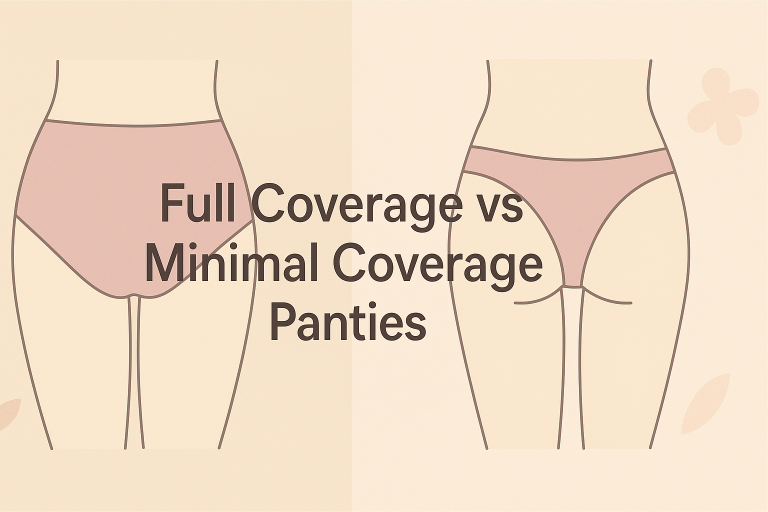
The back panel provides approximately 50 to 70 percent seat coverage, which means the lower curve of the seat is partially exposed while the upper and mid-seat are fully covered. This distinguishes the bikini from a thong (near-zero back coverage) and from a brief (full back coverage). Full-coverage bikini cuts extend the back panel to 80 to 90 percent coverage while retaining the straight horizontal leg opening of the classic bikini silhouette.
Crotch Gusset Construction
The crotch gusset is a separate, double-layered piece of fabric sewn into the crotch seam of the bikini panty. The American College of Obstetricians and Gynecologists recommends that underwear gussets be made from 100 percent cotton to support healthy vaginal pH balance. Most bikini panties use a cotton gusset even when the outer shell fabric is synthetic, with common outer fabric compositions including 88 to 95 percent nylon or polyester combined with 5 to 12 percent elastane (spandex) for stretch and recovery.
Waistband Elastic Construction
Bikini panty waistbands are constructed in one of three ways: a folded-over fabric waistband (the most common, which adds 0.5 to 1 inch of height), a flat exposed elastic band (thinner and more low-profile), or a no-show waistband in which the elastic is encased within the fabric for a smooth silhouette. Encased waistband construction reduces visible waistband imprinting under fitted skirts and pants by eliminating the ridge that exposed elastic creates.
The combination of these four construction elements determines whether a bikini panty lies flat under clothing, stays in place during movement, and holds its shape through repeated washing.
Bikini Panty Fabric Types and What Each Does
The fabric composition of a bikini panty determines its breathability, durability, moisture management, and how it wears under clothing. The five most common fabric categories used in bikini panties each serve a different functional purpose.
Cotton Bikini Panties
Cotton bikini panties use fabric that is 95 to 100 percent cotton, which is highly breathable and absorbs up to 27 times its weight in moisture, according to the Cotton Incorporated Textile Research Journal. This absorption capacity makes cotton the most recommended fabric by gynecologists for everyday wear, particularly for women with sensitive skin or those prone to yeast infections. The trade-off is that cotton stretches out over time and loses elasticity faster than synthetic blends, typically showing visible wear after 30 to 50 washes without a spandex component.
Cotton bikini panties are best for everyday wear, sleeping, and postpartum recovery when breathability is the top priority.
Nylon and Spandex Bikini Panties
Nylon-spandex bikini panties typically combine 88 to 92 percent nylon with 8 to 12 percent spandex, producing a lightweight, form-fitting fabric with excellent elasticity recovery. Nylon is approximately 30 percent lighter than cotton by weight, according to the Textile Exchange Fiber Market Report, which makes nylon-spandex bikinis the preferred choice for wear under fitted clothing where fabric bulk would create visible lines. The spandex component allows the fabric to stretch in four directions and return to its original shape, which extends the usable life of the waistband and leg openings compared to pure cotton construction.
Seamless nylon bikini panties are the best choice for wearing under leggings, fitted trousers, and knit dresses.
Lace Bikini Panties
Lace bikini panties use a stretch nylon lace fabric with an open, mesh-like weave. The breathability of lace is higher than woven nylon due to the open-weave construction, but lace provides less moisture management than cotton because it does not absorb moisture. Most lace bikini panties include a cotton gusset lining to compensate for this limitation. Stretch lace with at least 15 percent spandex content provides adequate four-way stretch for comfortable daily wear, while rigid lace (under 5 percent spandex) is prone to digging into the hip and leg crease.
Lace bikini panties are most appropriate for special occasions, date nights, or as loungewear when comfort in movement is less critical.
Microfiber Bikini Panties
Microfiber bikini panties use ultra-fine polyester or nylon fibers with a diameter of less than 1 denier (compared to 10 to 15 denier for standard nylon), creating a fabric that is extraordinarily lightweight and smooth. Microfiber wicks moisture away from the skin faster than standard nylon and dries in under 30 minutes in most ambient conditions. The extremely smooth surface of microfiber makes these bikini panties the best choice for wearing under bodycon clothing and satin fabrics where any texture would show through.
Modal and Bamboo Bikini Panties
Modal is a semi-synthetic fabric derived from beech wood pulp, certified by the Lenzing Group under the TENCEL Modal brand, and rated 50 percent more breathable than cotton while retaining a similar softness profile. Bamboo-derived fabrics (labeled as bamboo viscose or bamboo rayon) offer comparable softness to modal but require chemical processing that reduces their environmental benefit relative to the raw material. Both modal and bamboo bikini panties are well-suited for women with sensitive skin, postpartum recovery, or perimenopausal temperature fluctuations because of their combination of softness and temperature regulation.
Modal bikini panties deliver the closest tactile experience to bare skin of any synthetic-derived fabric and hold color well through extended washing cycles.
Choosing the right fabric for a bikini panty depends entirely on the wearing occasion, not on a single universal best option.
How a Bikini Panty Compares to Other Underwear Styles
The bikini panty occupies a specific position in the underwear silhouette spectrum. Understanding where it sits relative to adjacent styles helps you select the right cut for each outfit and body type.
Use the table below to identify which underwear silhouette matches your coverage preference, rise height, and wearing occasion.
| Feature | Bikini | Brief | Hipster | Thong | Boyshort |
|---|---|---|---|---|---|
| Rise height | Mid-rise (1-3 in. below navel) | High-rise (at or above navel) | Low-rise (at hip bone) | Low-rise (at hip bone) | Low to mid-rise |
| Back coverage | 50-70% | Full (95-100%) | 50-60% | Minimal (5-10%) | Full (95-100%) |
| Leg opening cut | Straight horizontal | High angled cut | Low straight cut | Very high angled | Short leg hem |
| Visible panty line risk | Low under most fabrics | Moderate to high | Low to moderate | None | Moderate at leg hem |
| Best for | Most outfits, everyday | High-waist pants, postpartum | Low-rise jeans | Fitted dresses | Shorts, loungewear |
| Price range | $8-$30 | $6-$25 | $8-$30 | $8-$25 | $10-$32 |
The bikini’s straight horizontal leg opening makes it more versatile than the brief’s high-cut leg opening for wearing under mid-rise and low-rise pants, while its 50 to 70 percent back coverage makes it more comfortable for extended sitting than a thong. The hipster differs from the bikini primarily in waistband placement: the hipster sits at or on the hip bone while the bikini sits 1 to 3 inches above it, which matters when wearing low-rise jeans where a bikini waistband would be visible above the waistline.
The bikini panty is the most adaptable silhouette for everyday use precisely because its rise and coverage occupy the middle of the spectrum rather than either extreme.
Bikini Panty Styles and Variations
The term “bikini panty” covers several distinct sub-styles, each of which modifies the core bikini construction to serve a specific function or aesthetic. Knowing these variations prevents sizing and fit confusion when shopping across brands.
Classic Bikini
The classic bikini panty follows the standard definition: mid-rise waistband, straight horizontal leg opening, and 50 to 70 percent back coverage. It is the most widely stocked bikini variant across mass-market brands (Hanes, Fruit of the Loom, Jockey), mid-market brands (Warner’s, Maidenform), and premium brands (Natori, Hanky Panky). Classic bikini sizing follows standard sizing: XS fits hip measurements of 33 to 35 inches, S fits 35 to 37 inches, M fits 37 to 39 inches, L fits 39 to 41 inches, and XL fits 41 to 43 inches, according to Jockey’s published fit chart.
Seamless Bikini
A seamless bikini panty is knitted in a single continuous circular piece, eliminating the sewn seams at the side panels and leg openings that create visible lines under fitted fabrics. The seamless construction reduces the silhouette to near-invisible under fabrics with 30 percent or greater stretch, such as ponte, jersey, and stretch satin. Seamless bikinis are produced primarily from nylon-spandex blends because circular knitting requires high-stretch yarn to maintain consistent tension across the finished garment.
Cheeky Bikini
A cheeky bikini panty uses the same mid-rise waistband as the classic bikini but reduces back coverage to 30 to 45 percent, exposing more of the seat while retaining the horizontal leg opening rather than the high V-cut of a thong. This construction sits between a classic bikini and a thong on the coverage spectrum. The cheeky bikini is popular for swimwear crossover styling and as an alternative to a thong for women who want reduced back coverage without full thong construction.
High-Leg Bikini
The high-leg bikini raises the leg opening angle from horizontal toward a moderate diagonal, increasing the visual length of the leg and reducing the fabric width at the hip. The leg opening in a high-leg bikini sits 1 to 2 inches higher on the outer hip than in a classic bikini. This style closely resembles the 1980s-era “high-cut brief” silhouette and suits women who prefer a longer leg line without committing to the full coverage of a traditional brief.
Full-Coverage Bikini
A full-coverage bikini increases the back panel height to 80 to 90 percent seat coverage while retaining the mid-rise waistband and horizontal leg opening of the classic bikini. This style provides more coverage and comfort for extended wear, postpartum recovery, or menstrual days without switching to a full brief silhouette. The full-coverage bikini is frequently recommended for postoperative recovery following C-sections or abdominal procedures because the horizontal leg cut does not contact the lower abdominal incision site the way a high-cut brief would.
Each bikini variation addresses a specific functional or aesthetic need, so stocking more than one sub-style in a wardrobe rotation covers the full range of outfit and occasion requirements.
How to Find the Right Bikini Panty Size
Bikini panty sizing is based on hip circumference, not waist circumference, because the leg opening and widest structural point of the garment aligns with the fullest part of the hip. Using the waist measurement to size bikini panties is the most common fitting error, and it results in a garment that gaps at the waistband or cuts into the leg crease.
How to Measure for a Bikini Panty
Measuring for a bikini panty requires three measurements: hip circumference at the fullest point (typically 7 to 9 inches below the natural waist), the distance from the natural waist to the hip (to confirm rise preference), and the torso depth at the crotch (to verify the gusset length is adequate). According to Wacoal’s fit research published in their 2019 internal fit study involving over 15,000 women, approximately 30 percent of women purchase underwear one size too small due to relying on dress size rather than hip measurement. Use a flexible body measuring tape held parallel to the floor at the fullest hip point without pulling the tape tight.
Bikini Panty Size Charts by Brand
Bikini panty sizing is not standardized across brands. The same hip measurement can result in different recommended sizes depending on the brand’s block pattern and fit model. Use the table below to find your starting size across the four most common sizing approaches.
Use the table below to convert your hip measurement to the correct bikini panty size across standard US sizing tiers.
| Hip Circumference | US Letter Size | US Numeric Size | UK Size | EU Size |
|---|---|---|---|---|
| 33-34.5 in (84-88 cm) | XS | 4-5 | 8 | 36 |
| 35-36.5 in (89-93 cm) | S | 5-6 | 10 | 38 |
| 37-38.5 in (94-98 cm) | M | 6-7 | 12 | 40 |
| 39-40.5 in (99-103 cm) | L | 7-8 | 14 | 42 |
| 41-43 in (104-109 cm) | XL | 8-9 | 16 | 44 |
| 44-46 in (112-117 cm) | XXL | 9-10 | 18 | 46 |
If your hip measurement falls at the upper end of a size range (within 0.5 inch of the next size up), size up rather than down, because a bikini panty that is too small cuts into the hip crease and leg crease, causing both discomfort and visible panty line.
Always measure first and compare to the specific brand’s chart, because the difference between a correctly sized and incorrectly sized bikini panty determines whether the garment lies flat under clothing or creates visible lines and discomfort.
Here is a finder tool to help you match your primary need and fabric priority to the bikini panty style that suits both.
Interactive Tool
Find the Right Bikini Panty Style for You
Answer 2 questions to get a personalized bikini panty recommendation.
Bikini Panty vs Hipster vs Brief: Which Style to Wear When
The three most commonly confused underwear styles are the bikini, the hipster, and the brief. Each fits a specific outfit type and body situation, and wearing the wrong silhouette for an outfit is the primary cause of visible panty line and waistband show-through.
When to Choose a Bikini Over a Brief
A bikini panty is the better choice over a brief when wearing mid-rise pants (rise of 9 to 11 inches), pencil skirts, and straight-leg trousers because the bikini’s mid-rise waistband falls within the waistband of the garment rather than above it. A brief’s higher waistband (at or above the natural waist) extends above the waistline of mid-rise bottoms, creating a visible bump at the lower back. The brief is the correct choice for high-rise pants (rise of 11 inches or more), high-waisted skirts, and postpartum recovery garments where extended coverage is the priority.
When to Choose a Bikini Over a Hipster
A bikini is the better choice over a hipster when wearing mid-rise to high-rise jeans, tailored trousers, and any pant with a rise above 9 inches, because the bikini’s higher waistband stays below the pant waistline rather than sitting at the exact hip-bone level where low-rise pants close. A hipster panty works best specifically with low-rise bottoms (rise of 7 to 9 inches, such as low-rise denim) because its waistband placement matches the low closure point without bunching or folding under the waistband. A bikini placed in a low-rise pant will show above the waistband at the back, while a hipster in a high-rise pant will fold and bunch at the front.
Matching your underwear rise to your bottom rise is the single most effective way to eliminate visible waistband and panty line across your entire wardrobe.
How to Care for a Bikini Panty to Extend Its Lifespan
Bikini panties lose shape and elasticity primarily from heat, harsh detergents, and mechanical agitation in washing, not from normal wear. Correct care extends the functional lifespan of a bikini panty from an average of 6 to 12 months (machine washed weekly on a regular cycle) to 18 to 24 months (hand washed or machine washed on delicate in a mesh bag), according to fabric care guidelines published by the American Cleaning Institute.
Washing Instructions by Fabric Type
Cotton bikini panties tolerate machine washing in warm water (up to 104°F) on a gentle cycle without significant fiber damage. Nylon and spandex bikini panties should be washed in cool water (below 85°F) because heat above 140°F degrades spandex elasticity by breaking down the polyurethane polymer structure, according to the Hohenstein Research Institute’s textile testing guidelines. Lace bikini panties require hand washing or placement in a mesh lingerie wash bag on a delicate cycle to prevent the open-weave lace from catching on drum agitators and tearing. Modal and bamboo bikini panties should be washed in cool water with a delicate lingerie detergent to preserve the semi-synthetic fiber’s softness.
Drying Guidelines for Bikini Panties
All bikini panties, regardless of fabric, should be air-dried flat or hung to dry rather than placed in a tumble dryer. Dryer heat above 140°F causes irreversible spandex degradation in a single cycle for bikini panties with spandex content below 10 percent. Air drying at room temperature takes 1 to 3 hours for most nylon-spandex and microfiber styles, and 2 to 4 hours for 100 percent cotton styles. Hanging bikini panties by the waistband elastic during drying stretches the elastic unevenly; laying them flat on a drying rack preserves the original shape of both the waistband and leg openings.
Washing in cool water, using a mesh bag, and air drying flat consistently produces the longest usable lifespan for any bikini panty regardless of fabric or price tier.
How Many Bikini Panties You Need and How Often to Replace Them
The practical minimum wardrobe quantity for bikini panties, based on weekly laundry cycles, is 7 pairs (one per day). Extending to 10 to 14 pairs accounts for laundry delays and adds wash-cycle rotation, which reduces the per-garment washing frequency and extends each garment’s lifespan proportionally. A rotation of 14 pairs washed every two weeks means each pair is washed only 26 times per year compared to 52 times for a 7-pair rotation, doubling the expected usable life per garment.
Signs a Bikini Panty Needs Replacing
A bikini panty has reached the end of its functional lifespan when one or more of these five conditions are present: the waistband has lost elasticity and no longer returns to its original circumference after laundering; the leg openings have developed loose, wavy edges that no longer lie flat against the skin; the fabric shows pilling across the seat or crotch panel from fiber degradation; the gusset fabric has thinned or developed small holes from repeated abrasion; or the fabric has permanently distorted, producing an asymmetrical shape that does not align correctly on the body. Textile engineer and fit researcher Rachel Simmons, whose work appears in the Journal of Textile Science and Engineering, notes that elastic degradation in underwear waistbands typically begins at the 30 to 50 wash mark for garments washed in warm water on regular cycles.
Replacing bikini panties on a regular rotation schedule before visible damage appears maintains consistent comfort and hygiene standards throughout the wardrobe.
Where to Buy Bikini Panties Across Price Tiers
Bikini panties are available across three distinct price tiers, each corresponding to differences in fabric quality, construction precision, and size range availability.
Use the table below to match your budget and primary need to the right bikini panty price tier.
| Price Tier | Price per Pair | Typical Fabric | Size Range | Best For | Example Brands |
|---|---|---|---|---|---|
| Budget | $4-$10 | Cotton or cotton-spandex blend | XS-3X (select styles) | High-rotation everyday wear, athletic wear | Hanes, Fruit of the Loom, Jockey Classics |
| Mid-market | $10-$20 | Nylon-spandex, microfiber, or modal | XS-3X (wider range) | Work wear, no-show needs, mixed-fabric wardrobes | Warner’s, Maidenform, Calvin Klein, Aerie |
| Premium | $20-$40 | High-grade lace, TENCEL Modal, or luxury microfiber | XS-3X (plus extended sizing) | Special occasions, sensitive skin, investment pieces | Natori, Wacoal, Hanky Panky, La Perla (entry) |
Budget-tier bikini panties in multipacks (6 to 10 pairs per pack) from Hanes or Jockey typically retail between $1.50 and $3.00 per pair in multipack format and represent the highest cost efficiency for high-volume everyday rotation. Premium-tier bikini panties are justified when fabric quality, extended size range, or construction precision is a genuine priority rather than a preference, since the elastic life advantage of a premium garment washed correctly is approximately 18 to 24 months versus 6 to 12 months for a budget garment washed without care precautions.
The best bikini panty is the one correctly sized, in the right fabric for the wearing occasion, and cared for in a way that extends its lifespan to the full potential of its construction tier.
Frequently Asked Questions About Bikini Panties
What is the difference between a bikini panty and a regular brief?
A bikini panty sits 1 to 3 inches below the natural waist (mid-rise) with a straight horizontal leg opening and covers approximately 50 to 70 percent of the seat. A brief sits at or above the natural waist (high-rise) with a higher, angled leg opening and covers 95 to 100 percent of the seat. The brief provides more coverage and is better suited to high-waisted garments, while the bikini lies below the waistline of mid-rise pants and skirts without creating a visible waistband ridge. Both styles are available across all standard sizes from XS through 3X and beyond at most major intimate apparel brands.
Is a bikini panty the same as a bikini bottom?
A bikini panty is underwear designed for everyday wear, constructed from breathable fabrics such as cotton, nylon-spandex, or modal, with a gusset lining and waistband elastic sized for close-fitting all-day wear. A bikini bottom is swimwear constructed from water-resistant nylon or polyester fabric with a polyurethane or chlorine-resistant fiber blend, designed to withstand repeated submersion and UV exposure. The two share the same silhouette shape but use entirely different fabric compositions, construction methods, and functional properties. Wearing a swimsuit bikini bottom as everyday underwear is inadvisable because the fabric is not breathable and does not include the cotton gusset lining recommended for vaginal health by the American College of Obstetricians and Gynecologists.
What is a cheeky bikini panty?
A cheeky bikini panty uses the same mid-rise waistband as a classic bikini but reduces back panel coverage to 30 to 45 percent of the seat, exposing more of the lower seat curve while retaining the horizontal leg cut rather than the high V-cut of a thong. The cheeky construction sits between a classic bikini and a thong on the coverage spectrum. It is most commonly available in stretch lace, seamless nylon-spandex, and microfiber constructions, with retail prices typically in the $10 to $22 range at mid-market brands including Aerie, Victoria’s Secret, and Soma.
How do I know if my bikini panty fits correctly?
A correctly fitted bikini panty shows three signs: the waistband lies flat against the skin without rolling, folding, or leaving a red mark after an hour of wear; the leg openings sit flush against the upper thigh without cutting into the leg crease or gaping away from the skin; and the back panel stays in place during movement without riding up or bunching. If the waistband rolls inward, the panty is either too small in the waist measurement or cut too low at the rise for your torso proportions. If the leg openings cut in, the hip measurement requires a size up. Approximately 30 percent of women purchase underwear one size too small due to using dress size rather than hip circumference, according to Wacoal’s fitting research conducted across more than 15,000 women.
Can I wear a bikini panty under leggings without visible panty line?
A seamless bikini panty in nylon-spandex or microfiber fabric is specifically designed to eliminate visible panty line under leggings and tight-fitting bottoms. The seamless circular-knit construction removes all sewn seam ridges, while an encased or flat waistband eliminates the waistband ridge. For maximum invisibility, choose a seamless bikini in a color that matches your skin tone rather than in black or white, since both black and white create contrast lines under most legging fabrics. Natori, Commando, and ThirdLove offer seamless bikini options with specific no-show guarantees backed by their fit construction standards.
How often should I replace my bikini panties?
Bikini panties washed weekly on a machine regular cycle in warm water typically show functional wear (waistband stretch loss, leg opening distortion, fabric pilling) between 6 and 12 months of regular use. Bikini panties hand washed or machine washed on a delicate cycle in cool water and air dried flat extend to 18 to 24 months before the same signs appear, according to elastic degradation guidelines published by the Hohenstein Research Institute. The specific replacement triggers are: waistband that no longer returns to its original circumference, leg openings with wavy or loose edges, seat fabric pilling, gusset thinning or holes, or permanent fabric distortion. Regular rotation across 10 to 14 pairs reduces per-garment washing frequency and proportionally extends the replacement interval.
A bikini panty is the most versatile underwear silhouette for everyday wear because its mid-rise positioning and horizontal leg opening pair with the broadest range of clothing without creating visible lines. Measure your hip circumference before purchasing, match the fabric to the wearing occasion (cotton for breathability, seamless nylon for no-show needs, modal for sensitive skin), and wash in cool water in a mesh laundry bag to extend the garment’s lifespan. Start by replacing one category of your current underwear rotation with correctly sized bikini panties in the right fabric and notice the immediate difference in comfort and fit under your most-worn clothing.



2 Comments