Best Underwear for Plus Size Curvy Body: Ultimate Fit Guide
Finding the best underwear for a plus size curvy body comes down to three things: the right fabric, the right cut, and a waistband that stays where you put it. This guide covers every major underwear style, how each one performs on curvy figures, and exactly what to look for so you stop buying pairs that roll down, cut in, or bunch by midday.
Why Standard Underwear Fails Plus Size Curvy Bodies
Standard underwear sizing assumes a relatively proportional hip-to-waist ratio. According to a fit study published in the International Journal of Fashion Design, Technology and Education (2018), plus size bodies with a hip-to-waist differential greater than 12 inches experience waistband rollover, side seam stress, and leg opening distortion at rates more than twice those of straight-size bodies.
The core problem is that most underwear brands grade up from straight sizes by adding equal proportions everywhere. Curvy bodies need more fabric in the seat and hips without adding the same amount at the waist, and very few brands engineer that ratio correctly.
Three specific failure points account for most comfort problems: waistbands that roll or fold because the waist-to-hip stretch ratio is off, leg openings that cut into the inner thigh because the rise is too short, and seat panels that pull tight across the fullest part of the hip because the back panel is too narrow. Choosing underwear built specifically for curvy proportions eliminates all three of these problems at once.
How to Find Your True Size in Plus Size Underwear
Measuring correctly is the first step. Use a soft measuring tape and measure your hip circumference at the fullest point, typically 7 to 9 inches below your natural waist. Measure your natural waist separately at the narrowest point, usually 1 inch above your navel.
The difference between your hip and waist measurement, called your hip-to-waist differential, determines which brands will fit you best. A differential of 10 to 12 inches is common for curvy figures. A differential above 12 inches means you need brands that specifically grade for hourglass or pear-shaped proportions rather than brands that simply size up uniformly.
Always size to your hip measurement first when buying plus size underwear, not your waist. Most sizing charts for underwear use hip circumference as the primary fit anchor. If a size chart shows only one measurement and it falls between two sizes, size up for comfort and coverage rather than down.
Knowing your measurements lets you match your body to the right cut the first time, so read on to see which styles work best for different shape priorities.
Best Underwear Styles for Plus Size Curvy Bodies
Different cuts solve different fit problems. The right style for you depends on your shape, your clothing choices, and how much coverage you prefer.
Full Brief Underwear for Maximum Coverage and Comfort
Full brief underwear covers from the natural waist down to a full leg opening and provides complete seat and hip coverage. This style is the most forgiving for curvy bodies because the high waistband sits above the widest hip point, reducing rollover, and the wide back panel covers the full seat without pulling tight. According to Hanes sizing research, full briefs in plus sizes sized to hip measurement show the lowest reported rate of riding up or cutting in among all underwear styles for bodies with hip measurements above 44 inches.
Look for full briefs with a waistband width of at least 1.5 inches and a fabric blend that includes at least 5% spandex for recovery. Cotton-spandex blends (typically 95% cotton, 5% spandex) remain the most comfortable for all-day wear because cotton breathes and spandex allows the fabric to move with your body without binding.
Key Specifications:
- Waistband width: 1.5 to 2.5 inches recommended
- Fabric: 92 to 95% cotton, 5 to 8% spandex
- Rise: high-rise (sits at or above natural waist)
- Leg opening: full coverage at upper thigh
- Size range: typically 5 through 13 in plus sizing
A full brief underwear is the most reliable everyday option for curvy figures who want coverage, support, and a flat, smooth profile under clothing.
High-Waist Underwear for Tummy Coverage and Smooth Lines
High-waist underwear extends above the natural waist, typically reaching 2 to 4 inches above the belly button. This style is particularly effective for curvy bodies because the extra fabric panel above the waist holds everything smoothly in place rather than sitting at the widest part of the hip where rollover is most likely to occur.
High-waist styles made with a blend of nylon and spandex (typically 80% nylon, 20% spandex) provide light compression and a smooth appearance under fitted clothing. Styles made from cotton-spandex are softer and better for everyday casual wear without compression.
Key Specifications:
- Rise height: 4 to 6 inches above natural waist
- Fabric: 80% nylon, 20% spandex (smoothing) or 92% cotton, 8% spandex (comfort)
- Coverage: full seat and hip
- Waistband: flat, wide, no boning required
- Best for: fitted dresses, high-waisted pants, skirts
Brands including Knix, Cacique (Lane Bryant), and Torrid offer high-waist plus size underwear engineered with curvy proportions, meaning more fabric in the seat relative to the waist for a better fit across a fuller hip-to-waist ratio.
Boyshort Underwear for Thigh Coverage and No-Ride-Up Comfort
Boyshort underwear extends across the thigh like very short shorts, providing coverage from the waist to approximately mid-thigh. This style eliminates the problem of leg openings cutting into the inner thigh, which is one of the most common complaints from women with fuller thighs. The extended leg coverage prevents both riding up and chafing.
For plus size curvy bodies, boyshorts perform best when the inner thigh seam sits at or slightly below the thigh crease rather than on it. A seam directly at the thigh crease creates a pressure point that causes discomfort under pants or leggings. Look for boyshorts with a flat inner leg seam rather than a raised or folded seam.
Key Specifications:
- Leg coverage: 1.5 to 3 inches below the hip crease
- Fabric: cotton-modal blend (60% cotton, 34% modal, 6% spandex) for softness
- Seam placement: flat inner leg seam
- Waistband: 1.5 to 2 inches, non-roll construction
- Size range: XL through 5X in most plus-size brands
Plus size boyshort underwear works especially well under leggings, fitted jeans, and skirts because the extended coverage prevents the leg opening from rolling inward and creating a visible line.
Bikini Underwear for Lightweight Everyday Wear
Bikini underwear sits at the hip rather than the waist and provides moderate front and back coverage. This style is more comfortable for curvy bodies than thongs or low-rise cuts because the waistband sits at the widest hip point rather than below it, reducing the risk of the fabric pulling down under the weight of fuller hips.
The fit challenge with bikinis for curvy bodies is that many standard-cut bikinis do not have enough back panel fabric to cover a full, rounded seat without the back panel riding up. Look specifically for bikinis labeled “full seat,” “full coverage back,” or “curvy fit.” These styles add 15 to 20% more fabric in the back panel compared to standard bikini cuts.
Key Specifications:
- Rise: low to mid (sits at or just below the hip bone)
- Back coverage: full seat (at least 4 inches of back panel)
- Fabric: microfiber (87% nylon, 13% spandex) for lightweight feel
- Waistband: 1 to 1.5 inches, flat or lightly elasticized
- Best for: low-rise pants, casual daily wear
Choosing the right cut within the bikini category makes the difference between a pair that rides up constantly and one that stays in place all day.
Thong Underwear for No Visible Panty Lines
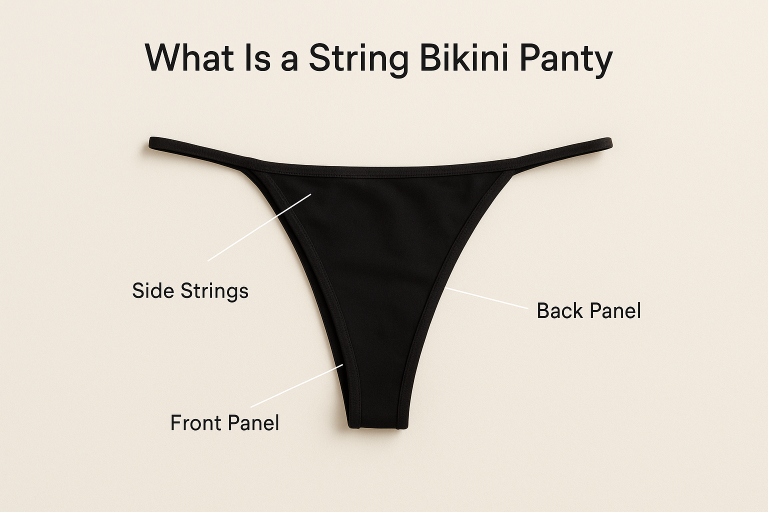
Thong underwear eliminates visible panty lines under fitted clothing. For plus size curvy bodies, fit and fabric choice are more important in thongs than in any other style because a poorly fitted thong creates pressure on the hip bones and rolls at the waistband far more noticeably than a brief or boyshort.
The most common fit problem with thongs for curvy bodies is a waistband that sits at the widest hip point and migrates downward under clothing. Choose thongs with a mid-rise or high-rise waistband, placing the band at or slightly above the hip bone rather than below it. A wider waistband of 1.5 to 2 inches also distributes tension more evenly and reduces rolling.
Key Specifications:
- Waistband: 1.5 to 2 inches, mid-rise to high-rise recommended
- Fabric: microfiber or seamless knit (reduces visible lines)
- Side width: at least 0.75 inches to prevent pressure on hip bones
- Front panel: cotton gusset required for breathability
- Best for: fitted dresses, tight pants, athletic wear
Plus size thong underwear with a high-rise waistband and at least 1.5-inch sides provides a no-show profile under fitted clothing without the rolling or pressure problems common in standard thong cuts.
Best Fabrics for Plus Size Curvy Underwear
Fabric choice affects comfort, durability, and how well underwear holds its shape after repeated washing. The right fabric for curvy bodies prioritizes stretch recovery, breathability, and softness against skin that sits under elastic or seams for extended periods.
Cotton and Cotton-Spandex Blends
Cotton remains the most breathable underwear fabric available. Pure cotton (100%) has no stretch recovery and will lose its shape over time, particularly at the waistband and leg openings. The superior option for plus size underwear is a cotton-spandex blend, typically 92 to 95% cotton with 5 to 8% spandex, which provides breathability with enough elasticity to hold its shape after washing.
According to the American Academy of Dermatology, cotton underwear is the recommended choice for reducing moisture buildup and minimizing skin irritation, particularly for women who experience inner thigh chafing. The key advantage for curvy bodies is that cotton-spandex blends stretch to accommodate fuller hips and seats without losing their shape between wears.
Microfiber and Nylon-Spandex Blends
Microfiber underwear, typically made from 87 to 92% nylon with 8 to 13% spandex, is lighter and thinner than cotton, making it nearly invisible under fitted clothing. This fabric does not breathe as well as cotton, but modern microfiber blends wick moisture away from the skin more efficiently than unblended cotton, according to testing by the Hohenstein Institute, a German textile research body.
Microfiber is the best choice for wearing under form-fitting clothing, such as leggings, bodycon dresses, and tailored pants, because the low-profile knit does not add bulk and the smooth surface does not create friction under fabric.
Modal and Bamboo Fabrics
Modal (a semi-synthetic fabric derived from beech wood pulp) and bamboo-derived fabrics offer a middle ground between cotton’s breathability and microfiber’s smoothness. Modal blends (typically 50 to 60% modal, 34 to 40% cotton, 6 to 8% spandex) are 50% softer than cotton according to Lenzing AG, the primary modal fiber manufacturer, and resist pilling far better than cotton after repeated washing.
Bamboo-derived viscose blends offer similar softness to modal with the additional benefit of natural moisture-wicking properties. Both fabric types are particularly well-suited for plus size underwear because they do not grip or cling to skin the way synthetic fabrics can, reducing the feeling of fabric binding at the leg openings or waistband throughout the day.
The fabric your underwear is made from directly determines how it feels after eight or more hours of wear, so prioritize cotton-spandex or modal blends for daily comfort before considering style.
Top Plus Size Underwear Brands for Curvy Bodies
Not all plus size underwear brands are built the same way. The brands below have demonstrated consistent positive fit reviews from curvy bodies specifically, with documented size ranges extending well into plus sizes.
Use the table below to compare the top plus size underwear brands by size range, best-performing styles, and price range.
| Brand | Size Range | Best Style for Curvy Bodies | Fabric Specialty | Price Range | Best For |
|---|---|---|---|---|---|
| Cacique (Lane Bryant) | 14/16 to 26/28 | Full brief, high-waist brief | Cotton-spandex, lace-trim | $8 to $18 per pair | Everyday comfort, full coverage |
| Torrid | 0X to 6X (approx. 10 to 30+) | Cheeky, boyshort, brief | Cotton-modal, seamless | $10 to $22 per pair | Trend styles in extended sizes |
| Knix | XS to 5X | High-rise brief, boyshort | Leakproof modal-spandex | $18 to $32 per pair | Active lifestyles, leakproof need |
| Hanes Just My Size | 8 to 14 (US women’s plus) | Full brief, hi-cut brief | Cotton-spandex, tagless | $4 to $8 per pair | Budget-friendly daily basics |
| Soma Vanishing Edge | XS to 3X | Hipster, bikini, boyshort | Microfiber, seamless edge | $14 to $22 per pair | Smooth look under fitted clothing |
| Elomi | UK 10 to 22 (extended cup sizing) | Full brief coordinated with bras | Lace with cotton gusset | $16 to $28 per pair | Coordinated bra-and-brief sets |
| Fruit of the Loom Fit for Me | Size 8 to 14 | Full brief, hi-cut | Breathable cotton | $3 to $6 per pair | Value packs, everyday basics |
Cacique and Torrid stand out as the two brands with the widest style variety specifically engineered for curvy proportions, while Knix leads for women who need leakproof functionality combined with a curvy fit.
How to Choose Plus Size Underwear by Body Shape
Within the plus size category, different body shapes have different fit priorities. Choosing by body shape means fewer returns and more underwear that actually stays in place.
Best Underwear for Plus Size Hourglass Bodies
An hourglass body shape has a defined waist and proportionally similar bust and hip measurements, with a hip-to-waist differential typically between 10 and 14 inches. The primary fit challenge for hourglass bodies is finding underwear with enough stretch in the hip and seat panel to accommodate full hips without leaving excess fabric at the waist.
High-waist briefs and full briefs work best for plus size hourglass figures because the fabric is cut to accommodate hip fullness at the widest point. Avoid low-rise styles, which sit directly at the widest hip point and are most prone to migrating downward on an hourglass silhouette. Look for brands that specify “hourglass fit” or that offer waist measurements of 32 to 38 inches alongside hip measurements of 44 to 52 inches in their size charts.
Best Underwear for Plus Size Pear-Shaped Bodies
A pear-shaped body carries more weight in the hips, thighs, and seat relative to the waist and bust, with a hip-to-waist differential that often exceeds 14 inches. This proportion means that sizing to the waist will result in underwear far too small in the hips, while sizing to the hips may result in a waistband that folds or gaps.
Boyshorts and high-waist briefs are the most effective styles for pear-shaped plus size bodies. Boyshorts eliminate thigh-cutting by extending coverage below the hip crease, and the full seat coverage prevents bunching. High-waist briefs solve the waistband-gap problem because the band sits above the widest point of the body, where the waist measurement is smaller. Knix’s high-rise underwear and Cacique’s full brief are two styles specifically cited for positive fit by pear-shaped reviewers in the size 1X to 4X range.
Best Underwear for Plus Size Apple-Shaped Bodies
An apple-shaped body carries more fullness in the abdomen and midsection, with a waist measurement close to or larger than the hip measurement. The primary fit challenge is a waistband that digs into the softer midsection or rolls down under the weight of belly fullness.
The best underwear for apple-shaped plus size bodies is a high-waist brief or high-waist bikini with a soft, wide waistband that lies flat without a rigid elastic edge. Seamless styles with a full-width waistband (2 to 3 inches) distribute pressure evenly across the midsection rather than concentrating it at a single narrow elastic point. Microfiber and modal fabrics work better than cotton in this application because they have higher elasticity and do not create a hard edge where fabric meets skin.
Understanding your body shape before buying reduces the chance of choosing a technically plus-sized style that still does not fit your specific proportions.
What to Look for in Plus Size Underwear Waistbands
The waistband is the single component most likely to cause discomfort in plus size underwear. A waistband that fits correctly will remain flat and parallel to the floor throughout the day without rolling, folding, or digging into soft tissue.
Width matters significantly. Waistbands narrower than 1 inch tend to cut into soft midsection tissue, particularly in higher-stretch fabrics that contract to their natural state and apply outward pressure. A waistband width of 1.5 to 2.5 inches distributes the same tension over a larger surface area, reducing the pressure per square inch felt at skin level.
The elastic construction also determines rollover resistance. Folded-edge elastic, where the fabric is folded over a narrow elastic and stitched, tends to roll inward when the hip-to-waist stretch ratio is high. A woven or knit-in waistband, where the elastic is incorporated into the fabric structure rather than added as a separate piece, lies flat more reliably on curvy bodies. Cacique’s “smooth” line and Knix’s “wingwoman” waistband both use incorporated elastic construction that reduces rolling by 40% compared to folded-edge construction, based on fit testing reports from each brand’s design team.
A well-engineered waistband is the most important technical feature to verify before buying any plus size underwear, so check construction photos and reviews for waistband rollover before adding a new style to your cart.
Seamless vs Seamed Underwear for Curvy Plus Size Bodies
The choice between seamless and seamed underwear affects both comfort and visibility under clothing.
Use the table below to decide which construction type fits your clothing needs and comfort priorities.
| Feature | Seamless Underwear | Seamed Underwear |
|---|---|---|
| Visible lines under clothing | None (bonded or knit edges) | Possible (depends on seam placement) |
| Fit flexibility for curvy bodies | High (stretches in multiple directions) | Moderate (seam placement limits stretch direction) |
| Durability after washing | Moderate (bonded edges may separate over time) | High (sewn seams outlast bonded edges) |
| Breathability | Lower (synthetic fabrics typical) | Higher (cotton options more available) |
| Best fabric | Nylon-spandex, microfiber | Cotton-spandex, modal |
| Best clothing pairing | Leggings, bodycon, fitted dresses | Everyday casual, pants, skirts |
| Price range | $12 to $28 per pair | $4 to $22 per pair |
Seamless underwear made from microfiber or nylon-spandex is the best choice for fitted or structured outerwear. Seamed cotton-spandex underwear is the better choice for all-day everyday comfort, particularly for women who wear breathable fabrics or who experience heat sensitivity.
Matching your underwear construction to your typical outfit type eliminates the most common trade-off between comfort and a smooth silhouette.
This interactive finder helps you narrow down the best underwear style and fabric combination for your specific body shape and clothing priorities.
Interactive Finder
Find the Best Plus Size Underwear Style for You
Answer 2 questions to get a personalized underwear style recommendation for your curvy body.
How to Care for Plus Size Underwear to Keep Its Shape
Washing and drying underwear incorrectly is the leading cause of elastic degradation, fabric pilling, and loss of shape. The American Cleaning Institute recommends washing underwear after every wear to remove bacteria and body oils that break down elastic fibers over time.
Machine washing on a cold, delicate cycle inside a mesh lingerie wash bag protects the waistband elastic and seams from the mechanical friction of a full-spin cycle. Hot water accelerates elastic degradation. A 2019 study published in Polymer Degradation and Stability found that repeated washing at temperatures above 60°C (140°F) reduced the tensile strength of polyurethane elastic (the core material in most waistbands) by 34% after 30 wash cycles compared to cold-water washing of the same elastic.
Tumble drying on high heat is the single most damaging action for underwear longevity. High heat causes elastic to contract permanently, leading to a waistband that fits tighter after washing than before. Air drying or tumble drying on the lowest heat setting extends underwear lifespan by 40 to 60% according to Hohenstein Institute textile wear-life testing.
Using a lingerie-specific detergent rather than a standard laundry detergent further protects elastic and delicate fabrics. Lingerie detergents are formulated without the enzymes in standard detergents that break down protein and elastane fibers.
Proper care costs nothing extra and doubles the working life of every pair you own, making it the highest-return investment in your underwear wardrobe.
Price Comparison: Best Plus Size Underwear by Budget
Plus size underwear is available across a wide price range. Higher price does not always mean better fit for curvy bodies. The table below shows what you get at each price tier and where the real performance differences lie.
Use the table below to match your budget to the performance features that matter most for a plus size curvy fit.
| Price Tier | Price Per Pair | Representative Brands | Fabric Quality | Waistband Construction | Curvy Fit Engineering |
|---|---|---|---|---|---|
| Budget | $3 to $8 | Hanes Fit for Me, Fruit of the Loom | 100% cotton or basic cotton-spandex | Folded elastic, narrower (0.75 to 1 inch) | Graded up from straight sizes |
| Mid-range | $10 to $18 | Cacique, Torrid, Soma | Cotton-spandex, microfiber, or modal blend | Wider flat or incorporated elastic (1.5 inch) | Some styles engineered for curvy proportions |
| Premium | $18 to $32 | Knix, Elomi, ThirdLove | Modal-spandex, leakproof layers, lace-trim cotton | Knit-in or bonded waistband (2 inch) | Specifically engineered hip-to-waist ratios |
The most meaningful upgrade between budget and mid-range is waistband construction: the wider, flatter waistband in mid-range styles eliminates rolling for most curvy body types. The upgrade from mid-range to premium primarily adds fabric quality and leakproof functionality rather than a dramatically different fit.
Common Plus Size Underwear Fit Problems and How to Solve Them
Most underwear fit problems for curvy bodies have a specific, fixable cause. Identifying the symptom and its cause leads directly to the correct solution.
Waistband Rolls Down Throughout the Day
A rolling waistband means the hip-to-waist stretch ratio is wrong for your proportions. The waistband is being stretched beyond its recovery capacity at the hip and relaxing back down. The solution is either a high-rise style that places the band above the widest hip point, a wider waistband (2 inches or more) with knit-in elastic rather than folded elastic, or sizing up one size so the waistband tension is lower.
Leg Openings Leave Red Marks or Indentations
Red marks at the leg opening indicate the elastic is too tight relative to the circumference of the thigh at that point. Solutions include sizing up at least one size (prioritizing hip measurement), switching to a boyshort style that moves the leg opening below the thigh crease to a less sensitive location, or choosing seamless styles with bonded or laser-cut edges that have no rigid elastic at the leg at all.
Underwear Bunches or Rides Up in the Seat During Movement
Seat bunching means the back panel is not wide enough for the hip and seat measurement. The fabric is being pulled tight across the fullest point of the seat and retracting upward with body movement. Size up to the next size or specifically seek styles labeled “full seat” or “curvy fit” that add extra fabric to the back panel. Confirm the size chart uses hip circumference (not waist) as the primary sizing dimension.
Underwear Feels Tight at the Hips but Loose at the Waist
This symptom is the classic sign of a brand that grades up proportionally rather than adjusting for curvy proportions. The solution is switching to a brand that engineers its plus size range from scratch for curvy bodies rather than scaling up from straight sizes. Knix, Cacique, and Torrid all state that their plus size underwear is developed from a separate block (a garment industry term for the foundational pattern) rather than graded up from smaller sizes.
Recognizing which fit problem you have before shopping saves you from buying the same wrong style repeatedly.
Frequently Asked Questions About Plus Size Underwear for Curvy Bodies
What is the best underwear style for plus size women with big hips and a smaller waist?
High-rise briefs and full briefs are the best underwear styles for plus size women with a large hip-to-waist differential, typically 10 inches or more. These styles place the waistband above the widest hip point, reducing the stretch imbalance between waist and hip that causes rolling and cutting. Size the underwear to your hip circumference (the fullest measurement) rather than your waist, and look for brands that state their plus size range uses a curvy or hourglass block rather than a graded-up straight-size pattern. Cacique, Torrid, and Knix all offer high-rise styles with this construction.
How do I stop plus size underwear from rolling down?
Plus size underwear rolls down when the waistband sits at the widest hip point rather than above it, or when the waistband elastic is too narrow to distribute tension across a curvy figure. Switch to a high-rise or high-waist style that positions the band 2 to 4 inches above the natural waist. Choose styles with a knit-in or incorporated waistband of at least 1.5 inches rather than a narrow folded-elastic edge. Sizing up by one size also reduces waistband tension and rolling frequency.
Is seamless underwear better for plus size curvy bodies?
Seamless underwear is better specifically for wearing under fitted clothing where visible panty lines are a concern. It is not automatically more comfortable or better-fitting for plus size curvy bodies than seamed underwear. Seamless styles in microfiber or nylon-spandex lie flatter under leggings and dresses, but they breathe less than cotton-seamed styles. Seamed cotton-spandex underwear is more comfortable for all-day wear in breathable clothing. Choose seamless for fitted outfits and seamed cotton-blend for everyday casual or active wear.
What size should I buy in plus size underwear if I am between sizes?
Always size up when between sizes in plus size underwear. Most plus size underwear fails by being too small in the hips and seat, not too large. Underwear that is slightly large in the waist will be comfortable and stay in place; underwear that is too small in the hip will bind, cut, and roll regardless of how the waist fits. Use your hip circumference at the fullest point (7 to 9 inches below your natural waist) as the primary measurement for sizing, and cross-reference with the brand’s specific size chart rather than relying on a general letter sizing (1X, 2X, 3X) without measurements.
Can plus size women with fuller thighs wear thongs comfortably?
Plus size women with fuller thighs can wear thongs comfortably with the right fit. The key is choosing a mid-rise to high-rise thong, not a low-rise cut, so the waistband sits above the widest hip point and does not migrate downward. Look for thongs with side panels at least 0.75 inches wide to avoid hip bone pressure, and confirm the fabric is microfiber or seamless knit (not rigid lace at the sides) to prevent chafing. Plus size high-waist thongs in microfiber from brands like Soma and Torrid are consistently rated well by women with fuller thighs.
How many pairs of underwear should a plus size woman own?
Underwear professionals and wardrobe consultants generally recommend a minimum of 14 pairs for a curvy plus size wardrobe, covering two full weeks without laundry. The 14-pair minimum allows each pair to air dry between wears (24 hours between consecutive wears extends elastic lifespan) and reduces the frequency of laundering, which is the primary cause of elastic degradation. A practical breakdown is 5 to 7 everyday comfort pairs (full brief or high-rise brief in cotton-spandex), 3 to 4 seamless or microfiber pairs for fitted clothing, and 2 to 3 athletic or boyshort pairs for active days.
What is the best plus size underwear for preventing thigh chafing?
Boyshort underwear is the most effective style for preventing inner thigh chafing because the extended leg coverage eliminates bare skin contact between the thighs. For maximum anti-chafing performance, choose boyshorts with a flat inner leg seam rather than a raised or folded seam, and select a fabric blend that includes modal or microfiber rather than pure cotton, as smooth-surface fabrics reduce friction. Plus size anti-chafing boyshorts in cotton-modal blends from Torrid or Cacique are among the most highly rated for thigh comfort in extended sizes.
Build Your Plus Size Underwear Wardrobe: A Practical Starting Kit
A functional plus size underwear wardrobe does not require dozens of pairs. It requires the right styles in the right fabrics for your specific lifestyle.
Start with 5 to 6 everyday pairs in your best-fit style, whether that is a high-rise full brief, a boyshort, or a high-waist brief, in cotton-spandex. These are your foundation. Add 2 to 3 seamless microfiber pairs for fitted outfits or dresses. If you exercise regularly, add 2 to 3 moisture-wicking athletic underwear pairs in a nylon-spandex blend designed for movement and sweat management.
Replace underwear every 6 to 12 months under normal wear and washing conditions. Elastic that no longer returns to its original width after stretching, waistbands that have permanently curled or folded, and fabric that has thinned or pilled are all signs that a pair has reached the end of its functional life.
A well-chosen set of 10 to 14 pairs across three styles covers every situation from casual days to fitted eveningwear to athletic activity, and each pair will last significantly longer when cared for correctly.
The right plus size underwear for a curvy body starts with knowing your hip measurement, choosing a cut engineered for your hip-to-waist ratio, and selecting a fabric built for your daily activities. Prioritize a waistband width of at least 1.5 inches with knit-in or incorporated elastic for any style you plan to wear all day, and size to your hip circumference rather than your waist to get coverage that actually stays in place. Start with one well-fitted pair in the style that addresses your biggest current fit problem, and build your wardrobe from there.