
How to Choose the Perfect Underwear: Fit, Fabric & Style
Choosing the perfect underwear comes down to matching three things: your body’s measurements, the fabric’s properties, and the specific activity or outfit you are dressing for. The wrong choice causes waistband digging, visible panty lines, chafing, and constant adjusting. This guide gives you a practical, measurement-based system for finding underwear that fits correctly, feels comfortable all day, and stays hidden under any outfit.
How to Measure Yourself for Underwear
Underwear sizing is based primarily on hip measurement, not waist measurement. Measuring correctly before you shop eliminates the guesswork that causes most fit problems.
How to Take Your Hip Measurement
Stand with your feet together and wrap a flexible measuring tape around the fullest part of your hips and seat, keeping the tape parallel to the floor. The American College of Healthcare Sciences recommends measuring twice and recording the larger number if the two readings differ by more than half an inch.
Write down your hip measurement in inches. Most US brands size underwear on hip ranges: XS covers 33 to 35 inches, S covers 35 to 37 inches, M covers 37 to 39 inches, L covers 39 to 42 inches, XL covers 42 to 45 inches, and 1X covers 45 to 47 inches.
How to Take Your Waist Measurement
Measure around the narrowest part of your natural waist, typically one to two inches above your navel. Waist measurement matters most for high-waisted styles, where a significant difference between your waist and hip measurement affects how the waistband sits.
A waist-to-hip ratio greater than 10 inches means you may need to size up in high-waisted styles to prevent the waistband from rolling or cutting in. For standard rise and low-rise styles, waist measurement is a secondary consideration.
Why Brand Sizing Varies So Much
A 2019 study published in the International Journal of Fashion Design, Technology and Education found that body measurement standards used by US apparel brands vary by as much as two inches within the same nominal size. This variation means a Medium from one brand may fit identically to a Large from another.
Always cross-reference your hip measurement with the specific brand’s size chart rather than relying on your standard letter size. Brands like Aerie, Parade, and ThirdLove publish detailed measurement-based size charts that reduce the chance of ordering the wrong size.
Getting your hip measurement right before you shop is the single most effective action you can take to avoid returns and discomfort.
Use this interactive calculator to match your hip measurement to your recommended US letter and numeric size instantly.
Sizing Tool
Panty Size Calculator by Hip Measurement
Enter your hip measurement to find your recommended US letter size and numeric size. Source: standard US manufacturer sizing charts.
Sizing reflects general US standards. Always check the specific brand’s size chart, since cut and stretch vary by style and fabric.
Measure around the fullest part of your hips while standing with feet together. Panty sizing is based primarily on hip measurement, not waist.
Understanding Underwear Styles and What Each One Does
Each underwear style is engineered to solve a specific fit or coverage problem. Choosing the right style for the situation eliminates discomfort before it starts.
Bikini Cut
Bikini-cut underwear sits at or just below the natural hip bone, with leg openings that cut straight across or at a slight angle. It is the most versatile everyday style, offering moderate seat coverage and a waistband that sits low enough to avoid showing above most mid-rise pants.
Key Specifications: Rise: low to mid, sits 1 to 2 inches below the natural waist. Coverage: moderate seat, half cheek. Fabric: commonly 95% cotton, 5% spandex or equivalent modal blend. Sizes: typically XS to 3X across most major brands. Machine washable.
Hipster Cut
Hipster-cut underwear sits lower on the hips than a bikini cut, with wider side panels and fuller seat coverage. It is the preferred everyday style for women who find bikini cuts ride up at the sides or provide insufficient rear coverage.
Key Specifications: Rise: low, sits at the hip bone. Coverage: full seat, extended side panels. Fabric: commonly cotton-modal blend or microfiber. Sizes: XS to 3X. Side panel width: approximately 1.5 to 2.5 inches, compared to 0.5 to 1 inch on a bikini cut.
Boyshort
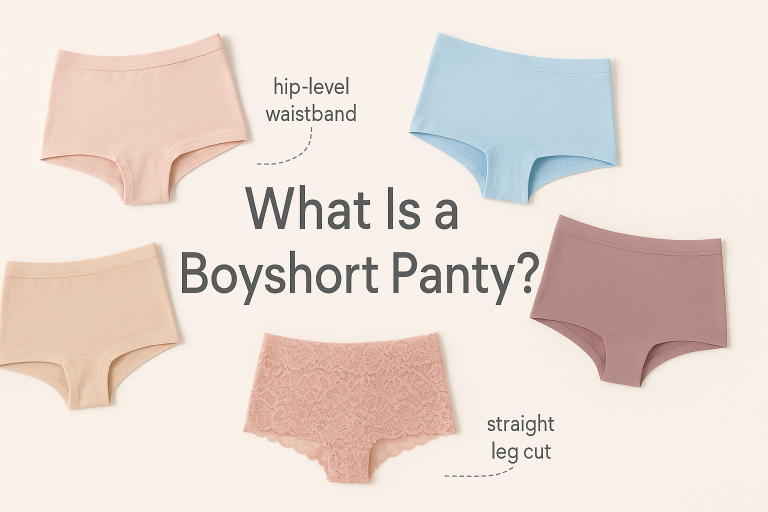
Boyshort underwear provides the most coverage of any non-shaping style, with leg openings that extend 1 to 3 inches down the thigh and a full seat panel. According to a consumer preference survey by Intimacy retail group, boyshorts rank first for at-home lounging comfort among women aged 25 to 44.
Key Specifications: Rise: low to mid. Coverage: full seat, partial thigh. Fabric: cotton, modal, or stretch microfiber. Leg extension: 1 to 3 inches below the seat crease. Sizes: XS to 3X. Prone to showing under fitted skirts or dresses shorter than mid-thigh.
Thong
Thong underwear eliminates visible panty lines (VPL) completely by replacing the seat panel with a narrow strip of fabric. It is the standard choice for fitted dresses, leggings, and skirts where any fabric impression shows through.
Key Specifications: Rise: low to mid. Coverage: front panel only. Fabric: typically microfiber, lace, or seamless knit. Back string width: 0.25 to 0.75 inches. Sizes: XS to 3X. Not recommended for post-surgical recovery or conditions affecting the perineal area, per Mayo Clinic guidance on intimate hygiene.
Cheeky Cut
Cheeky underwear sits between a bikini cut and a thong in terms of coverage, with a back panel that covers roughly half the seat. It reduces visible panty lines under most clothing while providing more comfort than a thong for extended wear.
Key Specifications: Rise: low to mid. Coverage: approximately 50% of seat. Fabric: microfiber, lace, or seamless knit. Back panel width: narrower than hipster, wider than thong. Sizes: XS to 3X.
Full Brief
Full-coverage brief underwear provides complete seat coverage with a waistband that sits at or near the natural waist. It is the most supportive everyday style and the standard recommendation for post-surgical comfort, according to the American Society of Plastic Surgeons post-operative care guidelines.
Key Specifications: Rise: mid to high, sits at or above the navel. Coverage: full seat, full front panel. Fabric: cotton, microfiber, or seamless knit. Waistband height: 2 to 4 inches. Sizes: XS to 5X. Preferred style for extended sitting, travel, and recovery periods.
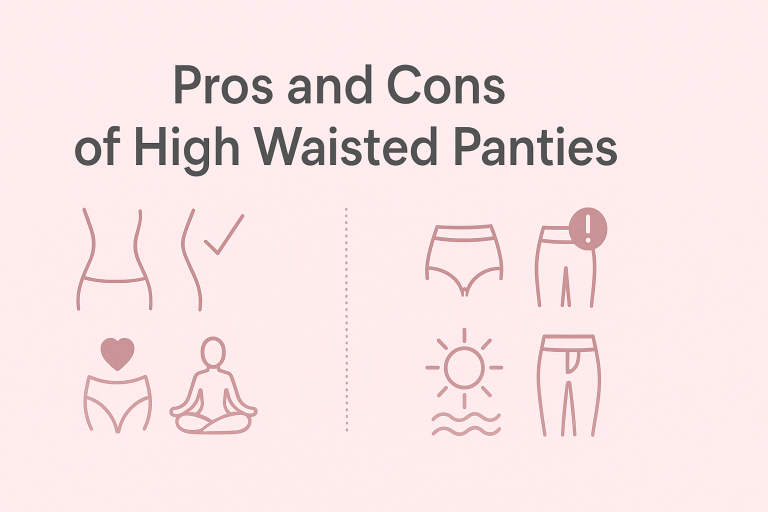
High-Waisted Brief
High-waisted underwear extends the front panel above the navel to smooth the lower abdomen without compression. It differs from shapewear in that it uses standard elastic fabric rather than graduated compression panels.
Key Specifications: Rise: high, sits 1 to 3 inches above the navel. Coverage: full seat, extended front panel. Fabric: commonly nylon-spandex blend or cotton-modal blend. Front panel height: 5 to 8 inches. Sizes: XS to 4X.
Matching the style to the outfit and activity, before thinking about fabric or brand, reduces unnecessary trial and error by the largest margin of any single underwear decision.
Choosing the Right Fabric for Comfort and Health
Underwear fabric affects moisture management, skin pH balance, breathability, and durability after repeated washing. The American College of Obstetricians and Gynecologists (ACOG) recommends cotton-lined gussets for all underwear styles as a baseline health standard.
Cotton
Cotton is the most breathable natural fiber used in underwear and the material recommended by dermatologists and gynecologists for daily wear. A 2017 study published in the Journal of Investigative Dermatology found that non-breathable synthetic fabrics in the intimate area raised local skin temperature by an average of 1.2 degrees Celsius, increasing conditions favorable to yeast overgrowth.
Cotton underwear absorbs up to 27 times its weight in moisture and allows air circulation that synthetic fabrics cannot match. The limitation of cotton is that it retains moisture once saturated, making it a poor choice for high-intensity exercise.
Modal
Modal is a semi-synthetic fiber made from beech tree pulp. It is 50% more moisture-absorbent than cotton, according to Lenzing AG, the primary industrial producer of modal fiber, and it retains its softness through significantly more wash cycles than standard cotton. See our related guide to environmentally conscious fabric choices.
Modal underwear drapes smoothly against the skin, making it a strong choice for everyday wear under fitted clothing where cotton might create minor texture impressions. Modal blended with a small percentage of spandex (typically 5 to 8%) gives it the stretch needed for active daily movement without distorting.
Microfiber and Nylon Blends
Microfiber and nylon-spandex blends are the standard construction material for seamless underwear styles. Their tight, smooth weave eliminates the fabric texture that creates visible panty lines under stretch fabrics like leggings and jersey dresses.
Seamless microfiber underwear dries approximately 30% faster than cotton, according to independent testing published by Consumer Reports in their activewear fabric review, making it more practical for workouts and travel. The primary limitation is that microfiber does not breathe as effectively as cotton, so ACOG guidelines recommend that any microfiber style include a cotton-lined gusset for daily wear.
Moisture-Wicking Synthetics
Performance-focused underwear for exercise uses moisture-wicking synthetic fabrics, typically polyester-elastane blends, that pull sweat away from the skin and disperse it across the fabric surface for rapid evaporation. Moisture-wicking underwear reduces chafing risk during activities that last longer than 45 minutes.
A 2020 study in the Journal of Sports Sciences found that moisture-managing fabrics reduced perceived discomfort scores by 34% during moderate-intensity workouts lasting 60 minutes compared to cotton. For yoga and low-impact movement, seamless sport underwear in a nylon-spandex blend provides movement flexibility without moisture accumulation.
Lace
Lace underwear is primarily a styling choice, but the fabric composition underneath the decorative lace overlay determines comfort and wearability. Quality lace styles use a stretch lace that contains at least 15% elastane to prevent the lace from cutting into skin at leg openings.
Lace underwear with an all-lace construction (no cotton gusset, no microfiber lining) is not recommended for daily extended wear by dermatologists due to the textured surface contact with sensitive skin. Look for styles that combine a decorative lace overlay with a cotton or modal-lined gusset and seat panel.
For all-day daily wear, cotton or modal provides the safest and most comfortable base, while seamless microfiber serves better when visible panty lines are the primary concern.
How Rise Height Affects Fit and Comfort
Rise height, the distance from the crotch seam to the top of the waistband, determines where the underwear sits on your torso and how it interacts with the pants or skirts you wear over it. Getting rise height right eliminates waistband show-through and rolling.
Low Rise
Low-rise underwear has a rise of 2.5 to 4 inches and is designed to sit below the hip bone, typically 3 to 5 inches below the natural waist. It pairs correctly with low-rise and mid-rise pants, jeans with a rise under 10 inches, and cropped tops where the waistband must stay invisible.
Low-rise styles are unsuitable for high-rise bottoms. A low-rise waistband on a high-rise pant creates a visible fabric ledge at the hip and causes the underwear to shift and roll throughout the day.
Mid Rise
Mid-rise underwear has a rise of 4 to 6 inches and sits at the hip bone to just below the natural waist. It is the most versatile rise height and pairs with the broadest range of pant and skirt styles, including mid-rise jeans (rise 9 to 11 inches) and standard-rise trousers.
Mid-rise styles are the best default choice when building an everyday underwear wardrobe because they work with 80 to 90% of standard bottom clothing, according to fit guidance published by the Underwear Expert, a sizing resource maintained by intimates industry specialists.
High Rise
High-rise underwear has a rise of 6 to 9 inches and sits at or above the natural waist. It pairs correctly with high-rise jeans (rise 11 inches or more), high-waisted skirts, and wide-leg trousers. It also provides the most abdominal coverage and is the standard recommendation for postpartum comfort during the first 6 to 12 weeks of recovery.
High-rise recovery underwear designed specifically for postpartum use typically features a wider, softer waistband than standard high-rise styles to accommodate C-section incision areas. ACOG recommends high-rise cotton or modal styles during the postpartum period due to their non-restrictive coverage.
Matching your rise height to your pants' rise measurement is the fastest fix for underwear that bunches, rolls, or shows above waistbands.
Use the table below to match your bottom's rise measurement to the underwear rise that eliminates waistband visibility.
| Bottom Rise (inches) | Correct Underwear Rise | Examples |
|---|---|---|
| Under 9 inches (low-rise) | Low rise (2.5 to 4 in.) | Low-rise jeans, mini skirts |
| 9 to 11 inches (mid-rise) | Mid rise (4 to 6 in.) | Everyday jeans, trousers, skirts |
| 11 to 13 inches (high-rise) | High rise (6 to 9 in.) | High-rise jeans, wide-leg trousers |
| 13 inches or more (ultra high-rise) | High rise (7 to 9 in.) or thong | Mom jeans, postpartum pants |
Mid-rise underwear paired with mid-rise bottoms is the most universally applicable combination and the safest default for building an everyday drawer.
Choosing Underwear for Specific Activities
Activity type is the second most important variable after measurement when selecting underwear. Each activity creates distinct demands on fabric performance, fit, and construction that everyday underwear cannot always meet.
Everyday Office and Casual Wear
For seated office work and light daily activity, the priority is comfort under sustained pressure and a waistband that does not dig in after several hours. Cotton or modal mid-rise styles with a soft, non-binding waistband outperform stiffer synthetic styles in this context.
Tagless underwear with a flat or no-show waistband reduces the irritation that develops from fabric tags and raised elastic bands during prolonged sitting. A waistband width of at least 1.5 inches distributes pressure more evenly than narrow bands, reducing the tendency to roll or dig in.
Exercise and High-Activity Days
High-intensity exercise requires moisture-wicking construction, flat seams or seamless edges at the leg openings, and a snug but non-restrictive fit that does not shift during movement. Cotton absorbs sweat but does not transport it away from the skin, increasing chafing risk during activities lasting more than 30 minutes.
For running and cycling, a seamless sport underwear style in a nylon-spandex blend with laser-cut leg openings eliminates the seam friction that causes thigh irritation at miles 3 to 5. For yoga and low-impact training, standard seamless microfiber styles perform equally to performance-specific styles, making dedicated exercise underwear unnecessary for low-impact activities.
Formal or Evening Wear
Fitted formal clothing, including bodycon dresses, pencil skirts, and jersey-knit evening wear, requires underwear that leaves zero fabric impression through the outer layer. The most effective options are seamless laser-cut styles in a smooth microfiber or a thong.
A laser-cut seamless underwear style eliminates the rolled-edge seam that a standard cut-and-sewn underwear creates under stretch fabric. The difference between laser-cut and standard seamless edges is visible under fitted jersey dresses, particularly when the wearer moves or bends.
Sleep and Lounge
Sleep underwear requires maximum breathability and zero constrictive elements. A 2015 study in the journal Fertility and Sterility, while primarily focused on male reproductive health and temperature regulation, reinforced the broader principle that intimate apparel worn during sleep should not elevate local skin temperature, a concern that applies equally to vulvar tissue health for women.
Sleep underwear in a lightweight cotton or bamboo-modal blend with a flat, non-elastic waistband provides the most comfortable overnight option. Many women choose to sleep without underwear entirely, a practice supported by gynecologists at the Cleveland Clinic as a valid option for reducing moisture accumulation in the intimate area overnight.
Period Days
Period underwear has built-in absorbent layers that replace or supplement menstrual products. Heavy-flow period underwear typically holds 2 to 4 teaspoons of fluid, equivalent to 2 to 4 regular tampons, according to absorbency testing published by Wirecutter's 2021 period underwear review. Light-day styles hold approximately 1 teaspoon.
The construction in most period underwear uses a three-layer system: a moisture-wicking inner layer, an absorbent middle layer (typically cotton terry or a proprietary blend), and a leak-resistant outer layer. Period underwear is not a one-to-one replacement for tampons or cups during very heavy flow unless the product explicitly states a high-absorbency rating.
Matching underwear to the specific demands of each activity is more effective than finding a single style that performs adequately at everything.
How to Identify a Good Fit and Spot Common Fit Problems
Correctly fitting underwear sits flat against the skin at every edge, creates no fabric pulling or puckering, and maintains its position without requiring adjustment throughout the day. Any deviation from this baseline signals a fit problem.
Signs the Underwear Is Too Small
Underwear that is too small creates visible indentation lines along the waistband and leg openings, leaves red marks on the skin after removal, and causes the fabric at the seat to pull taut or ride up continuously. These symptoms indicate the hip measurement exceeds the size range for that style.
The most common response to waistband digging is to stretch the elastic or choose a style with softer elastic, but the correct fix is sizing up one size. High-waisted underwear with a wide, fold-free band often eliminates this problem without requiring a full size change because the wider band distributes pressure over a larger surface area.
Signs the Underwear Is Too Large
Underwear that is too large bunches at the crotch, creates visible fabric folds under fitted clothing, and shifts position throughout the day. The waistband folds over on itself rather than lying flat.
Sizing down by one size is the correct correction. For women whose waist and hip measurements fall into different size brackets, choosing the size based on hip measurement and selecting a style with a stretchy, non-structured waistband (such as a fold-over yoga waistband) accommodates the waist without creating tightness at the hips.
Leg Opening Fit Problems
Leg openings that cut into the upper thigh indicate the style's cut is too high for the wearer's hip-to-thigh ratio. Switching from a bikini cut to a hipster or boyshort cut resolves this by lowering the leg opening to a position where thigh circumference is smaller.
Leg openings that gap away from the body indicate the opposite, where the elastic is too loose or the style is sized too large. A correctly fitted leg opening lies flush against the crease between the thigh and seat without creating any indentation or gap.
Waistband Rolling and Folding
A waistband that rolls inward repeatedly throughout the day is usually caused by a mismatch between rise height and pants rise, or by a waistband elastic that has degraded from repeated washing. The American Cleaning Institute recommends replacing underwear every 6 to 12 months under regular daily wear conditions, as elastic loses approximately 20 to 30% of its recovery after 50 to 60 wash cycles.
Solving the rolling problem requires identifying whether the cause is size, rise mismatch, or elastic degradation before replacing the underwear.
A correctly fitting underwear requires zero adjustment after you put it on in the morning, and that baseline is achievable for virtually every body shape and size.
The before-and-after panel below shows exactly what changes when you go from the wrong size and rise to the correct combination.
Fit Results
What Changes When You Choose the Correct Size and Rise
Common experience when switching from an incorrect fit to a correctly measured size and matched rise height.
Wrong Fit
- xWaistband digs in and leaves red marks after 4 to 6 hours
- xFabric rides up and requires adjustment every 1 to 2 hours
- xLeg openings cut into the upper thigh, creating visible lines
- xWaistband peeks above pants waistband throughout the day
- xVisible panty line through fitted skirts and dresses
Correct Fit
- +Waistband sits flat against skin all day with no marks
- +Zero riding up or repositioning required from morning to evening
- +Leg openings lie flush against skin with no indentation
- +Waistband stays hidden below the pants waistband at all rises
- +No visible fabric texture through fitted outer layers
Correct hip measurement combined with a rise height matched to your pants eliminates virtually all common everyday underwear fit problems.
Choosing Underwear for Special Circumstances
Postpartum recovery, pregnancy, and plus-size bodies each present fit requirements that standard sizing and style guidance does not fully address. Each circumstance requires a specific approach.
Postpartum Underwear
In the first two to four weeks after vaginal delivery, disposable underwear is the practical standard because it allows for the use of large postpartum pads and can be discarded rather than washed. Postpartum disposable underwear in a mesh or light cotton construction provides the most comfortable option for the immediate recovery period.
After the first month, transitioning to high-rise cotton briefs provides gentle support without compressing the perineal area. ACOG advises against shapewear or compression underwear near surgical sites (including C-section incisions) for a minimum of six weeks post-delivery, or until cleared by a physician.
Maternity Underwear During Pregnancy
Maternity underwear comes in two primary configurations: over-bump styles, which feature a panel that extends over the belly and provides support to the lower abdomen; and under-bump styles, which sit below the belly with a U-shaped front cut-out.
Over-bump maternity styles are more commonly recommended during the second and third trimesters because they support the growing belly without pressure. Under-bump styles suit women who find over-bump panels uncomfortable at the belly's top edge. Both styles should be sized based on pre-pregnancy hip measurement rather than current hip measurement, because the belly growth drives the sizing demand, not hip growth in most pregnancies.
Plus-Size Fit Considerations
Plus-size underwear (typically 1X to 5X) requires attention to two measurements: hip circumference and thigh circumference. Standard sizing charts use hip measurement as the primary variable, but for plus-size bodies with significant thigh fullness, leg openings sized purely on hip measurement may cut in at the thigh even when the waistband fits correctly.
Plus-size underwear brands that publish thigh circumference ranges alongside hip ranges, including Torrid, Cacique (Lane Bryant), and Aerie, allow for more accurate sizing than brands relying on hip measurement alone. Boyshort and hipster cuts are the most forgiving for varying thigh-to-hip ratios because their lower leg openings encounter smaller thigh circumference than higher-cut styles.
Sizing special-circumstance underwear based on the specific body measurement most affected by that circumstance, rather than defaulting to a standard letter size, prevents the most common fit failures in these categories.
How to Care for Underwear to Extend Its Life
Proper care extends underwear lifespan and maintains elastic recovery, which is the fabric's ability to return to its original shape after stretching. Elastic that loses recovery is the primary reason underwear fails before the fabric itself shows wear.
Washing Instructions by Fabric Type
Cotton and modal underwear tolerates machine washing on a warm or cold delicate cycle. Washing in hot water above 60 degrees Celsius (140 degrees Fahrenheit) degrades elastic by approximately 15 to 20% per cycle, according to fabric care research published by the American Cleaning Institute. Cold water washing on a gentle cycle with a lingerie-specific detergent preserves elastic recovery for the longest possible lifespan.
Lace, microfiber, and seamless styles benefit most from hand washing or placement in a mesh laundry bag inside the machine. The mechanical agitation of a standard wash cycle without a mesh bag causes lace fibers to snag and microfiber edges to fray within 20 to 30 cycles.
Drying Guidelines
Tumble drying on high heat is the single fastest way to degrade underwear elastic. High heat causes synthetic elastic fibers (typically spandex or elastane) to break down irreversibly, shrinking the elastic's effective length and reducing its ability to recover. Air drying at room temperature on a flat surface or drying rack extends underwear life by two to three times compared to regular tumble drying, according to Lenzing AG fabric care data.
Period underwear requires a specific care step: rinsing in cold water before washing removes blood proteins that would set permanently in warm or hot water. Period underwear manufacturers including Thinx and Modibodi specify cold-rinse as the first step in their official care instructions for this reason.
When to Replace Underwear
The American Cleaning Institute recommends replacing everyday underwear every 6 to 12 months under normal daily wear. The practical indicators for replacement are: elastic that no longer returns to its resting shape after removing the underwear, fabric that has thinned to the point of transparency at the seat, waistbands that roll despite correct sizing, and persistent shape distortion after washing.
Maintaining a drawer rotation of 7 to 10 pairs of everyday underwear allows each pair to rest between wears, reducing the total wash cycles per pair per year and extending the useful life of each garment. Storing underwear flat or loosely folded rather than tightly rolled also preserves elastic shape between wears.
Washing in cold water on a gentle cycle and air drying are the two highest-impact care habits for extending the functional life of any underwear fabric.
Building a Complete Underwear Wardrobe
A complete underwear wardrobe covers four functional categories: everyday comfort, no-show under fitted clothing, exercise, and special occasion or evening wear. Filling each category with two to three pairs per function provides coverage for a full weekly rotation without over-purchasing.
The Recommended Minimum Wardrobe
For a practical, purpose-built underwear drawer, the Underwear Expert and intimates industry consultants recommend a minimum of 14 pairs distributed across functions: four to five pairs of everyday cotton or modal mid-rise styles (bikini, hipster, or full brief), two to three pairs of seamless or laser-cut no-show styles for fitted clothing, two to three pairs of performance moisture-wicking styles for exercise, two pairs of high-waisted styles for high-rise bottoms, and one to two pairs of special occasion styles.
This minimum covers a full two-week rotation with one wash cycle per week, ensuring no pair is worn more than once per week under a regular schedule. Underwear worn more frequently per week ages proportionally faster due to additional wash cycles.
What to Prioritize When Shopping on a Budget
When purchasing underwear within a fixed budget, prioritize fabric quality over brand recognition and everyday comfort styles over specialty styles. A well-made cotton or modal everyday brief at $8 to $14 per pair from brands like Hanes Premium, Fruit of the Loom, and Aerie outperforms a poorly made designer style at three times the price because elastic recovery and fabric integrity, not branding, determine how long underwear performs correctly.
Buying multipacks of a proven style reduces per-pair cost by 20 to 40% compared to single-pair purchases. Three-packs and five-packs from established basics brands typically offer the lowest cost per pair without compromising on cotton weight or elastic quality.
A targeted wardrobe built around function covers every daily scenario with fewer pairs than an unfocused collection of similar everyday styles.
International Size Conversion When Shopping Overseas
Underwear sizing systems differ between the United States, United Kingdom, European Union, and France/Spain. A US size Large corresponds to a UK 14, EU 42, and FR/ES 44 based on a hip measurement of 40 to 42 inches.
Use the table below to convert your US underwear size to the equivalent size in UK, EU, and French/Spanish sizing systems.
Conversion Chart
Panty Size Conversion by Country
Hip measurement and size equivalents across US, UK, EU, and France/Spain sizing systems. Source: manufacturer sizing chart standards cross-referenced with ISO sizing guidelines.
| Hip (inches) | US Size | UK Size | EU Size | FR/ES Size |
|---|---|---|---|---|
| 34 to 35 | XS / 4-6 | 6 to 8 | 34 to 36 | 36 to 38 |
| 36 to 37 | S / 7-8 | 10 | 38 | 40 |
| 38 to 39 | M / 9-10 | 12 | 40 | 42 |
| 40 to 42 | L / 11-12 | 14 | 42 | 44 |
| 43 to 45 | XL / 13-14 | 16 | 44 | 46 |
| 46 to 48 | 1X / 15-16 | 18 to 20 | 46 to 48 | 48 to 50 |
Sizing systems vary by brand and country. Treat this as a starting reference, not an exact conversion. Always check the specific brand's size chart when shopping internationally.
Shopping from international retailers, using your hip measurement in centimeters as the search input, rather than your US letter size, produces the most accurate size match across EU and UK sizing systems.
Frequently Asked Questions About How to Choose the Perfect Underwear
What is the healthiest type of underwear to wear every day?
Cotton underwear with a cotton-lined gusset is the healthiest option for daily wear, according to ACOG and the American Academy of Dermatology. Cotton allows air circulation and absorbs moisture without trapping heat, which reduces conditions favorable to bacterial and yeast overgrowth in the intimate area. A 2017 study in the Journal of Investigative Dermatology found that non-breathable synthetic fabrics raised local skin temperature by an average of 1.2 degrees Celsius compared to cotton. Even seamless microfiber styles used for no-show purposes should include a cotton-lined gusset as a minimum health standard.
How do I know if my underwear size has changed?
The most reliable sign that your size has changed is that correctly fitting underwear from six to twelve months ago now digs in at the waistband, leaves marks at the leg openings, or rides up continuously. Body weight fluctuations of 10 pounds or more typically shift hip measurement by 0.5 to 1.5 inches, which may cross a size boundary. Remeasure your hips at the fullest point and compare to the brand's current size chart. Do not rely on your existing label size from older underwear, as elastic degradation can mimic sizing problems, so confirm by measuring rather than by eliminating elastic wear as the cause first.
Is it better to size up or down when between sizes?
Sizing up is the standard recommendation when your hip measurement falls at the top of one size range or the bottom of the next. The American Lingerie Federation's fit guidelines advise erring toward the larger size because underwear that is slightly too large can be managed with elastic adjustment, while underwear that is too small causes skin indentation, chafing, and discomfort that no adjustment can correct. The exception is seamless or stretch-heavy styles, where the fabric's stretch capacity means the smaller size may fit correctly without any restriction.
How many pairs of underwear should I own?
Industry guidance from intimates specialists recommends a minimum of 14 pairs for a full two-week rotation at one wash cycle per week. This ensures no pair is worn more than once weekly, which extends elastic life and reduces per-cycle fabric wear. A functional minimum of 7 pairs covers one full week with daily washing. Owning fewer than 7 pairs results in individual pairs being washed more frequently, which degrades elastic faster and shortens overall underwear lifespan, according to care data from the American Cleaning Institute.
Can wearing the wrong underwear cause health problems?
Wearing underwear that is too tight can restrict lymphatic circulation in the groin and cause skin irritation and folliculitis at leg openings, according to dermatologists at the Cleveland Clinic. Non-breathable synthetic fabrics worn daily for extended periods create conditions favorable to vulvovaginal yeast infections by raising local temperature and retaining moisture, as supported by research published in the Journal of Investigative Dermatology. ACOG also specifically advises against thong styles for women with recurrent urinary tract infections, since the narrow back panel can transfer bacteria from the rectal area more readily than full-coverage styles.
How often should I replace my underwear?
The American Cleaning Institute recommends replacing everyday underwear every 6 to 12 months under regular daily wear with weekly washing. The practical replacement indicators are elastic that no longer recovers its shape after the underwear is removed, fabric thinning at the seat or gusset to the point of transparency, waistbands that roll despite correct sizing, and persistent shape distortion that does not resolve after washing. Underwear washed in hot water and machine dried on high heat will require replacement closer to 6 months, while cold-washed and air-dried styles can last closer to 12 to 18 months before elastic degradation affects fit.
What underwear is best for working out?
Moisture-wicking seamless underwear in a nylon-spandex blend is the best choice for working out, outperforming cotton by 34% in perceived discomfort reduction during 60-minute moderate-intensity sessions, according to a 2020 study in the Journal of Sports Sciences. The key construction features are flat or laser-cut leg openings (to eliminate seam friction), a snug mid-rise or low-rise fit that does not shift during movement, and a fabric with at least 15% spandex content for four-way stretch. Moisture-wicking underwear with a cotton-lined gusset provides the best balance of performance and intimate health for activities lasting longer than 30 minutes.
Start with a hip measurement today, match it to a mid-rise cotton or modal style for everyday wear, and add one seamless no-show pair for fitted clothing. These two choices resolve the most common underwear fit complaints without requiring a full wardrobe overhaul, and every additional pair you add from there becomes a deliberate, purpose-matched decision rather than a guess.



2 Comments