Panty vs Underwear vs Knickers Difference Explained
Underwear, panties, and knickers all refer to the same essential garment, but each word carries a distinct geographic origin, cultural weight, and everyday usage pattern. Understanding which term applies where helps you shop internationally, read size labels correctly, and communicate clearly about intimate apparel across English-speaking markets.
What “Underwear” Actually Means and Where It Comes From
Underwear is the broadest term in English-language intimate apparel and functions as an umbrella category rather than a style-specific name. According to Merriam-Webster, the word “underwear” entered common usage in the mid-19th century and describes any garment worn beneath outer clothing, including bras, undershirts, and bottom garments.
In American English, “underwear” serves as both a singular and collective noun. A single garment is “a pair of underwear,” and the category as a whole is also called “underwear,” making it one of the most grammatically flexible terms in the intimate apparel lexicon.
Retailers in the United States, Canada, and Australia use “underwear” as the primary category label on product pages, packaging, and size charts. When a US retailer lists “women’s underwear,” the category typically includes bikini briefs, hipsters, thongs, boyshorts, and full briefs under a single heading.
“Underwear” is the neutral, clinical, and universally understood default across all English-speaking markets, making it the safest term when writing for a global audience or shopping from an international retailer.
What “Panties” Means and Who Uses It
“Panties” is the most common American English term for women’s bottom undergarments specifically, distinct from the broader “underwear” category. The word derives from “pantaloons,” a 19th-century term for long trousers, and the diminutive suffix “-ies” narrowed its meaning to small, fitted undergarments over the following century.
In the United States, “panties” refers exclusively to women’s and girls’ bottom underwear. It does not cover bras, undershirts, or men’s briefs, making it a narrower and more gender-specific term than “underwear.”
Major US lingerie retailers including Victoria’s Secret, Soma, and Nordstrom use “panties” as their primary product category label for women’s bottom undergarments. This usage is so standard in American retail that the word carries no unusual connotation in a US shopping context.
Outside North America, the word “panties” reads as informal or mildly antiquated in some markets, particularly in the United Kingdom, where “knickers” fills the same everyday role. Australian English accepts both “panties” and “undies” in casual conversation, though retail labeling more often defaults to “underwear.”
Common Panty Styles and Their Names
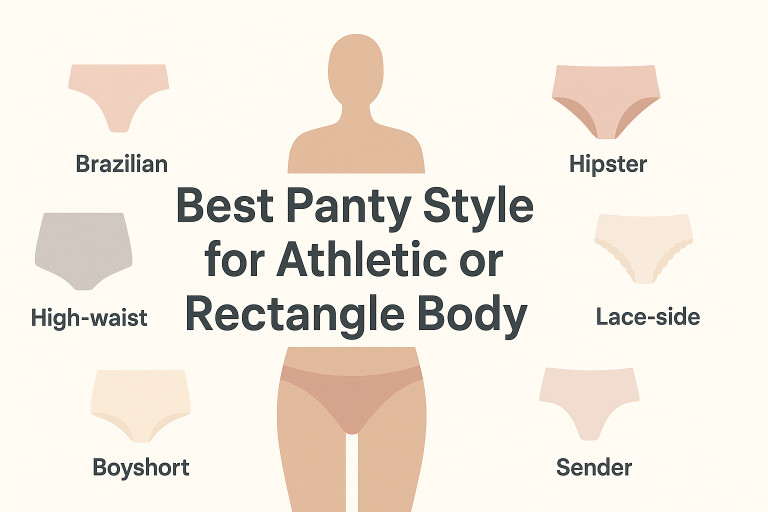
Within the “panties” category, American retailers use precise style names that describe cut, coverage, and waistline placement. The five most widely stocked styles are bikini, hipster, boyshort, thong, and brief.
Use the table below to match each style name to its coverage level and best-use scenario.
| Style Name | Waistline | Coverage | Best For |
|---|---|---|---|
| Bikini | Mid-rise | Moderate rear coverage | Everyday wear, jeans |
| Hipster | Low-rise | Full rear coverage | Low-rise trousers, comfort |
| Boyshort | Mid-rise | Full coverage, short-style leg | Dresses, anti-chafe |
| Thong | Low to mid-rise | Minimal rear coverage | Fitted clothing, no panty lines |
| Full Brief | High-rise | Full front and rear coverage | Postpartum, period days, comfort |
The bikini and hipster styles account for the largest share of women’s underwear sales in the US market, according to NPD Group retail data. Full briefs have seen consistent growth in demand, driven by postpartum and comfort-focused purchasing patterns.
Knowing the specific style name matters most when shopping online, where size charts and fit descriptions are tied to the style label rather than the general term “panties.”
What “Knickers” Means and Where It Is Used
Knickers is the standard British English term for women’s underwear (bottom garments) and functions in the UK exactly as “panties” does in the US. The Oxford English Dictionary traces the word to “knickerbockers,” loose-fitting trousers gathered at the knee worn in the 19th century. Over time, the term narrowed to describe women’s underpants in British usage.
In the United Kingdom, Ireland, Australia, New Zealand, and South Africa, “knickers” carries no unusual or impolite connotation. It is the everyday, neutral word used in retail, casual conversation, and media. Major UK retailers including Marks and Spencer, John Lewis, and ASOS UK use “knickers” as a primary category label alongside “briefs” and “shorts.”
In North American English, however, “knickers” primarily refers to a style of loose trousers worn in sports or historical dress rather than underwear. An American reader encountering “knickers” in a fashion context is more likely to picture golf trousers than underwear. This geographic split creates genuine confusion when shopping across UK and US retailers.
British Knicker Styles and Their US Equivalents
British knicker styles map closely to American panty styles but use different names for the same silhouettes. Understanding these equivalents prevents sizing and style errors when shopping UK brands.
Use the table below to match British knicker style names to their American equivalents.
| UK Term | US Equivalent | Coverage Level | Notes |
|---|---|---|---|
| Brief | Full brief / bikini | Moderate to full | Most common UK style |
| High-leg brief | Bikini cut | Moderate | Higher leg opening than standard brief |
| Shorts / boy shorts | Boyshort | Full | Identical silhouette, different name |
| Thong | Thong | Minimal | Same term used in both markets |
| Brazilian | Cheeky / hipster | Low rear coverage | More coverage than thong, less than brief |
The most important style name difference between UK and US markets is “brief,” which in the UK refers to standard everyday coverage, while in the US a “brief” or “full brief” implies higher-rise, more substantial coverage than a standard bikini. Always check the accompanying size chart image when ordering cross-market to confirm which silhouette you are purchasing.
When shopping UK knicker brands from a US location, the term “brief” is the most commonly misread label, and checking the product photograph before purchasing prevents returns.
Panty vs Underwear vs Knickers: The Core Differences Side by Side
The three terms differ primarily in geography, register (formal vs casual), and specificity (narrow vs broad). None of the three refers to a different physical garment. All three describe the same category of women’s bottom undergarments.
Use the table below to compare the three terms across the dimensions that affect real shopping and communication decisions.
| Dimension | Underwear | Panties | Knickers |
|---|---|---|---|
| Primary market | Global (all markets) | US, Canada | UK, Ireland, ANZ |
| Scope | Broad category (includes bras, undershirts) | Women’s bottom garments only | Women’s bottom garments only |
| Register | Neutral, clinical | Informal to neutral in US | Neutral in UK; informal in US |
| Gender specificity | Gender-neutral (used for all) | Women and girls only | Women and girls only |
| Retail label use | Used globally as category header | Standard in US retail | Standard in UK retail |
| US meaning of same word | Bottom and top undergarments | Women’s bottom underwear | Loose knee-length trousers (not underwear) |
The geographic split between “panties” and “knickers” is the single most important practical distinction, because it determines which search term to use when filtering results on international retail platforms like ASOS, Net-a-Porter, or Amazon’s regional stores.
All three terms refer to the same garment, but using the market-specific term dramatically improves search result accuracy and size chart relevance when shopping online.
Here is the decision tool to help you match the right term to your specific shopping or communication context.
Decision Tool
Which Term Should You Use: Underwear, Panties, or Knickers?
Answer a few quick questions for a tailored recommendation.
Why the Same Garment Has Three Different Names
The three terms exist as separate vocabulary items because British and American English developed independently after the 18th century, and intimate apparel terminology was particularly subject to regional variation due to social conventions around discussing underwear in public.
In the United States, “panties” became dominant in retail and advertising during the early 20th century as department stores expanded women’s ready-to-wear sections. The word was considered appropriately feminine and specific to women’s garments, distinguishing them clearly from men’s “underwear” or “briefs.”
In the United Kingdom, “knickers” became the standard term through the same period via a different linguistic path. The word derives from “knickerbockers,” loose trousers worn by men and boys in the 19th century, and was gradually applied to women’s undergarments as styles evolved. By the mid-20th century, “knickers” was fully established as the everyday British English term.
“Underwear” functions as the overarching hypernym for both terms. It belongs to a category that linguists call a superordinate term: a word at a higher level of abstraction that encompasses both “panties” and “knickers” as specific regional hyponyms within the same general category.
This linguistic split between markets is one reason why global intimate apparel brands maintain separate regional websites with different category labels, even when selling identical products.
How Sizing Differs When You Cross Markets
Understanding the terminology difference matters most when it affects sizing. US, UK, and EU sizing systems use different scales for women’s underwear, and the label conventions tied to each term reflect those different scales.
US underwear and panty sizing typically uses letter sizing (XS, S, M, L, XL, XXL) or numeric waist measurements in inches. A US size Medium typically corresponds to a 28 to 30 inch waist and hip measurements of 37 to 39 inches, according to Victoria’s Secret’s published size chart.
UK knicker sizing uses UK dress sizes expressed as even numbers (6, 8, 10, 12, 14, 16, 18, 20). A UK size 12 corresponds to approximately the same hip measurement as a US size Medium, but the two systems do not align perfectly across all brands. According to Marks and Spencer’s published size chart, a UK 12 corresponds to a 28 to 30 inch waist, consistent with a US Medium, but a UK 16 aligns closer to a US XL than a US L due to brand-specific grading differences.
EU sizing for women’s underwear uses centimeter-based waist or hip measurements (36, 38, 40, 42, 44, 46). A French size 40 is broadly equivalent to a UK 12 and a US Medium, according to standard EU conversion tables published by ASOS’s size guide.
The practical implication is that “knickers” on a UK site always means UK-sized garments, and “panties” on a US site always means US-sized garments. Ordering the same number or letter size across markets without checking the brand’s conversion chart is the most common cause of underwear fit errors when shopping internationally.
US, UK, and EU Underwear Size Conversion
Use the table below to convert your size across the three major market sizing systems before placing an international order.
| US Size | UK Size | EU Size | Approx. Waist (inches) | Approx. Hip (inches) |
|---|---|---|---|---|
| XS | 6 to 8 | 32 to 34 | 24 to 26 | 33 to 35 |
| S | 8 to 10 | 36 to 38 | 26 to 28 | 35 to 37 |
| M | 12 | 40 | 28 to 30 | 37 to 39 |
| L | 14 | 42 | 30 to 32 | 39 to 41 |
| XL | 16 | 44 | 32 to 34 | 41 to 43 |
| XXL | 18 to 20 | 46 to 48 | 34 to 37 | 43 to 46 |
The M/12/40 row represents the most commonly purchased size across all three markets, according to ASOS’s published size guide and Victoria’s Secret’s bestseller data. Always treat any cross-market size conversion as a starting estimate and verify against the specific brand’s own size chart, since grading varies by manufacturer.
When sizing crosses markets, a measurement tape and the brand’s own chart are more reliable than any general conversion table, because brands grade their sizes differently even within the same country.
Fabric Types Used Across All Three Terminology Markets
Whether labeled as underwear, panties, or knickers, women’s bottom undergarments share the same core fabric categories across all markets. The terminology difference does not indicate a difference in construction or material. However, fabric choice significantly affects comfort, breathability, and care requirements.
Cotton is the most widely recommended fabric for everyday women’s underwear across all markets. The American College of Obstetricians and Gynecologists specifically recommends cotton-crotch underwear for vaginal health, citing cotton’s breathability and moisture-wicking properties as factors that reduce the risk of irritation and infection.
Microfiber (typically nylon or polyester blends) is the most common fabric for seamless panties and knickers. Microfiber accounts for a significant portion of everyday underwear sales at mass-market retailers including Target and Marks and Spencer, valued for its smooth texture, stretch, and minimal show-through under fitted clothing.
Lace and nylon-lace blends are most common in lingerie-positioned underwear and knickers, typically constructed with a cotton or microfiber gusset even when the outer fabric is all-lace.
Use the table below to compare the four main fabric types across the dimensions that matter most for everyday wear.
| Fabric | Breathability | Moisture Management | Show-Through Risk | Best Use |
|---|---|---|---|---|
| 100% Cotton | High | Absorbs moisture | Moderate (thicker) | Everyday, sensitive skin, medical |
| Cotton-modal blend | High | Wicks and absorbs | Low (drapes smoothly) | Everyday comfort, warmer climates |
| Microfiber (nylon/polyester) | Moderate | Wicks quickly | Very low (seamless) | Fitted clothing, office, travel |
| Lace (nylon/polyester) | Moderate | Low (use cotton gusset) | Low to moderate | Special occasion, lingerie |
Cotton-modal blends have grown as a preferred everyday option because modal (a semi-synthetic fiber derived from beech wood pulp) adds softness and drape to the breathability benefits of cotton. Brands such as Hanky Panky, Eberjey, and Marks and Spencer’s Body range all use cotton-modal or modal-dominant blends in their core everyday collections.
For daily wear across all three terminology markets, a cotton or cotton-blend gusset is non-negotiable for hygiene and comfort regardless of the outer fabric.
How Retailers Use These Terms on Product Pages
The terminology a retailer uses on its product pages directly affects which results appear when you search, which size charts apply, and how the return and exchange process is labeled. Understanding the retail convention for your target market prevents confusion at every stage of the shopping process.
In the US market, Amazon categorizes women’s bottom undergarments under “Women’s Underwear, Panties and Thongs.” Victoria’s Secret uses “Panties” as its primary navigation label. Target uses “Women’s Underwear.” All three terms appear in the US Amazon search index, meaning that women’s underwear, women’s panties, and women’s briefs all return relevant results on Amazon US.
In the UK market, ASOS UK uses “Knickers and Briefs” as a navigation category. Marks and Spencer uses “Women’s Knickers.” John Lewis uses “Women’s Briefs and Knickers.” Searching “panties” on UK retail sites typically still returns results but may yield a narrower set than searching “knickers” or “briefs.”
On global multi-market platforms, “women’s underwear” consistently returns the broadest and most geographically varied results. This makes it the most reliable search term for shoppers comparing options across brands from multiple countries.
Using the market-specific term when searching a regional retail site reliably returns the most complete category results, while “underwear” serves as the universal fallback on any platform.
Terms That Overlap and Terms That Do Not
“Underwear,” “panties,” and “knickers” all overlap at the level of the garment they describe. Three other closely related terms, however, occupy distinct positions in the category and are worth distinguishing: briefs, thongs, and lingerie.
“Briefs” is used in both US and UK retail as a style-specific term, referring to a garment with moderate-to-full coverage and a waistband at or near the natural waist. In the US, “briefs” most often refers to men’s underwear or the high-rise “full brief” style in women’s garments. In the UK, “briefs” is used interchangeably with “knickers” for everyday women’s styles and is considered slightly more formal in register.
“Thong” is one of the few style names used identically in both US and UK markets without regional variation. Both markets describe a minimal-coverage style with a narrow strip at the back as a “thong,” and retailers in both regions use this label consistently.
“Lingerie” is a broader category term that encompasses decorative, lace, or silk intimate apparel, including underwear sold primarily for aesthetic rather than functional purposes. “Lingerie” is used in both markets and does not replace “panties” or “knickers” as an everyday term. Lingerie-positioned underwear is typically a subcategory of “panties” in the US and “knickers” in the UK, not a replacement category.
The terms “underwear,” “panties,” “knickers,” and “briefs” all refer to the same garment type, but each carries a different geographic default, register, and scope that affects search results, sizing, and communication.
Which Term to Use When Shopping Online
Choosing the right search term for an online underwear purchase is a practical skill that reduces returns and improves search result accuracy. The optimal term depends on the platform’s regional base, the sizing system it uses, and the style you are looking for.
On Amazon US, searching women’s panties returns style-filtered results with US sizing (XS through 3X) and American-brand-dominant results. Adding the style name, such as bikini panties, hipster panties, boyshort underwear, or high waist underwear, narrows results to the correct silhouette immediately.
On UK platforms, searching women’s knickers or “women’s briefs” returns UK-sized results. Searching by style, such as cotton briefs or “lace shorts,” narrows results to specific silhouettes within UK sizing.
When purchasing across markets, always complete these three steps before adding to cart: confirm which sizing system the brand uses (US letter, UK numeric, or EU centimeter), measure your waist and hips in inches or centimeters on the same day as ordering, and compare your measurements against the brand’s specific size chart rather than a general conversion table.
Searching with the platform’s native terminology and measuring before every cross-market purchase eliminates the two most common causes of underwear fit errors.
Frequently Asked Questions About Panties vs Underwear vs Knickers
Are panties and knickers the same thing?
Panties and knickers are the same garment described by two different regional English terms. “Panties” is the standard term in American and Canadian English for women’s bottom undergarments. “Knickers” is the standard term in British, Irish, Australian, and New Zealand English for the same garment. Both words describe the same styles, from bikini briefs to thongs to boyshorts, and neither term implies a specific style or fabric. The difference is purely geographic vocabulary.
Is “underwear” the same as “panties”?
“Underwear” is a broader category term that includes panties (women’s bottom garments) as well as bras, undershirts, vests, and men’s briefs. “Panties” is a narrower term that refers specifically to women’s bottom undergarments only. In practice, many US retailers use “underwear” and “panties” interchangeably in the women’s category, but technically “underwear” encompasses all undergarments while “panties” refers only to the bottom half. When a US retailer labels a category “Women’s Underwear,” it may include only bottom garments or may also include bras depending on the site’s structure.
Why do British people say knickers instead of panties?
British English and American English developed separate vocabulary for intimate apparel during the 19th and early 20th centuries, a period when discussing undergarments in public was socially constrained and regional language conventions became entrenched through retail and media. “Knickers” entered British usage through the word “knickerbockers,” a style of loose trousers from the 1800s. “Panties” entered American usage through department store retail marketing during the early 20th century. The two terms became established in their respective markets independently and remain the dominant regional vocabulary to this day.
What do people call underwear in Australia?
Australians use several terms interchangeably for women’s underwear. “Undies” is the most common casual Australian English term and applies to both women’s and men’s underwear. “Knickers” is also used and understood in Australian English, adopted from British English. “Underwear” is used in formal and retail contexts. “Panties” is understood in Australia but is considered more American in register. Australian retail sites, including Australian ASOS and Target Australia, typically label the category “Women’s Underwear” or “Women’s Undies” on product pages.
Does “knickers” mean something different in the US?
In American English, “knickers” primarily refers to a style of loose, wide-leg trousers gathered at the knee, not to underwear. This style was historically worn for golf, cycling, and boys’ schoolwear in the 19th and early 20th centuries. When an American reader encounters “knickers” in a non-UK fashion context, they are likely to picture this trouser style rather than underwear. This is the most significant single-word meaning difference between British and American English in the intimate apparel category, and it is the primary reason why US shoppers searching UK retail sites for the first time can be confused by the category label “knickers.”
What is the most universal term for women’s underwear?
“Underwear” is the most universally understood term across all English-speaking markets and carries the most neutral register. It is understood without confusion in the US, UK, Canada, Australia, New Zealand, Ireland, South Africa, and India. When writing for a global audience, using “underwear” avoids the geographic specificity of “panties” (North American-coded) and “knickers” (British and Antipodean-coded). “Briefs” is also widely understood across markets as a specific style term and functions as a close second-choice universal term.
Do UK knickers and US panties use the same sizing?
UK knickers and US panties use different sizing systems and the numbers are not interchangeable. US sizing uses letter grades (XS, S, M, L, XL, XXL) or numeric waist measurements in inches. UK sizing uses even-number dress sizes (8, 10, 12, 14, 16, 18, 20). A US Medium is broadly equivalent to a UK 12, and a US Large is broadly equivalent to a UK 14, according to ASOS’s published cross-market size guide. However, brand-specific grading means these conversions are estimates only. Always measure your waist and hips and check the specific brand’s size chart before ordering from a cross-market retailer.
Understanding whether a product is sized in US, UK, or EU measurements is the most important sizing step when buying seamless underwear, cotton underwear, or lace underwear from international retailers. Use the brand’s own size chart, measured against your current waist and hip measurements, for every cross-market purchase to avoid returns.